When Blood Pressure Numbers Disagree
Review date: 2026-09-17 · Credential: 1105*********91
Abstract
When Blood Pressure Numbers Disagree
International Heart Care Center: When Blood Pressure Numbers Disagree – How to Organize Records and Schedule a Follow-up
When measuring blood pressure at home, systolic and diastolic pressure may not rise or fall in sync. A single occurrence is insufficient to determine the cause or diagnose a condition. The more practical approach is to first rule out obvious measurement interference, keep standardized records continuously, and then have a healthcare professional review them along with symptoms, previous blood pressure readings, medications, and other tests.
This article is for medical and health education and does not replace a doctor's diagnosis, prescription, or individualized treatment advice.
First Address Safety Boundaries: Do Not Repeatedly Measure at Home When Readings Are Accompanied by Severe Discomfort
Blood pressure values need to be interpreted together with your current physical condition. If abnormal readings are accompanied by persistent or worsening chest pain, severe shortness of breath, fainting, altered consciousness, or sudden facial drooping, limb weakness, or difficulty speaking, do not repeatedly measure to get a "more accurate" number or wait for a regular clinic response.
You should promptly contact local emergency services or a healthcare professional and follow local emergency guidelines. If you are alone, notify someone who can assist as soon as possible, and have your address, current medications, and known medical conditions ready. A blood pressure monitor cannot rule out an emergency, and a temporary return to normal readings does not mean the danger has passed.
What Systolic and Diastolic Pressures Record in the Cardiac Cycle
A single blood pressure result usually includes two numbers. Systolic pressure is the pressure recorded when the heart contracts and pumps blood into the arteries, and diastolic pressure is the pressure recorded when the heart relaxes between beats. The two numbers reflect different phases of the cardiac cycle, so they may not change in the same way.
Many factors affect readings, including measurement technique, recent activity, emotions and environment, and your underlying health. A single result with "one high, one low" cannot determine whether it is a temporary fluctuation, a measurement error, or a repeated pattern that needs further evaluation. Whether it is abnormal depends on the applicable population, the target range set by your doctor, and consecutive records.
First Check Cuff, Posture, Rest Time, and Measurement Environment
Before re-measuring, complete the following checks:
Use a cuff that fits your upper arm circumference and place it directly on bare skin as instructed by the device manual.
Rest quietly before measuring; avoid talking, moving around, or measuring immediately after activity.
Sit with a stable posture, back supported, feet flat on the floor, and legs uncrossed.
Relax your arm and support it so the cuff is roughly at heart level.
Measure in a quiet, comfortable-temperature environment, and use the same device, arm, and time of day consistently.
Follow the device instructions; if you need to repeat measurements, keep every result, not just the one that matches expectations.
If the device repeatedly shows errors, the cuff is clearly unsuitable, or results vary greatly within the same period, note these issues. During the follow-up, ask medical staff to check your measurement technique and compare your home device with the clinic's equipment as appropriate.
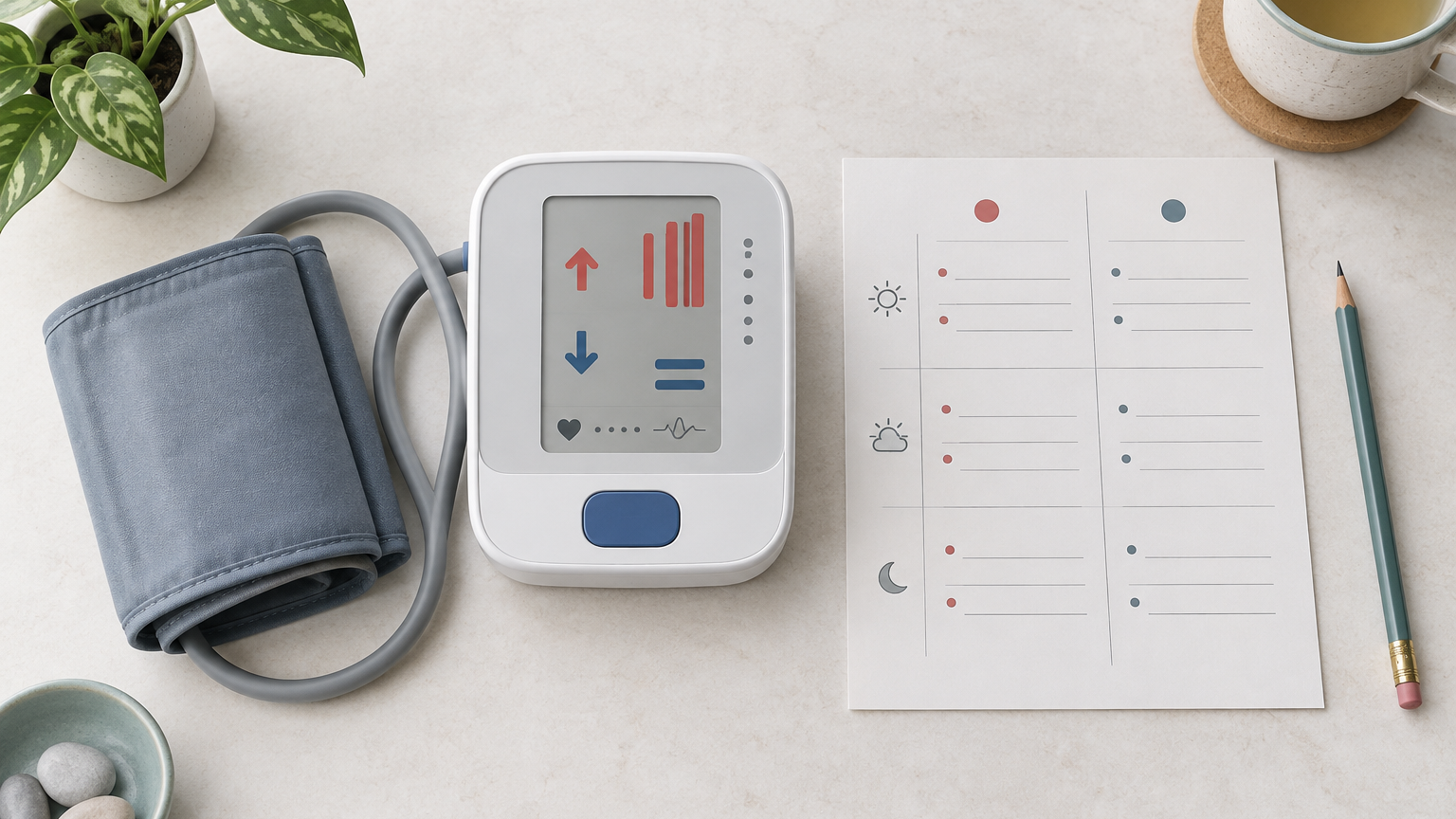
Three-Day Record Table: Keep Both Numbers, Pulse, Time, and Concurrent Symptoms
The purpose of a consecutive three-day record is to provide healthcare professionals with more complete observations, not to make a diagnosis yourself. The timing and frequency of daily measurements should follow your doctor's previous instructions; if there are no individualized requirements, ask for a specific plan when scheduling.
Date and Time | Systolic | Diastolic | Pulse | Arm and Posture | Concurrent Symptoms and Notes |
|---|---|---|---|---|---|
Day 1 | |||||
Day 2 | |||||
Day 3 |
The notes column can record whether you were active recently, emotionally stressed, missed or just took medication, device errors, and concurrent feelings such as chest tightness, dizziness, or palpitations. Do not delete readings that differ significantly to make the record look neat, and do not alter the numbers shown by the device.
How to Identify Occasional Readings vs. Repeated Patterns of Difference
When organizing records, look for "whether it repeats," but do not try to name the pattern yourself. A single reading after rushing, talking, unstable posture, or improper cuff placement has many possible explanations; similar differences occurring repeatedly under similar conditions and fixed times deserve to be highlighted during the follow-up.
Organize using these clues:
Whether the difference occurs occasionally or consecutively multiple times.
Whether it always appears at a certain time of day, after certain activities, or before/after medication.
Whether adjacent measurements vary greatly, and whether the device indicates arrhythmia or measurement errors.
Whether the difference is accompanied by discomfort, and how long symptoms last.
Whether there is a significant change compared to previous blood pressure levels confirmed by medical staff.
Home records help identify trends but cannot explain the cause alone. Different ages, underlying diseases, pregnancy status, and medications may affect the evaluation, and the final judgment should be made by a healthcare professional familiar with your medical history.
Bring Device Model, Complete Medication List, and Past Blood Pressure Data to the Follow-up
Before the appointment, compile a one-page summary and be prepared to show the original records. Bring or provide:
Blood pressure monitor brand, model, purchase/calibration status, and cuff size.
Complete three-day readings, including unfiltered repeated measurements.
Names, doses, times, and recent changes of prescription drugs, over-the-counter drugs, and supplements.
Past blood pressure records, related test results, and management goals set by your doctor.
Known cardiovascular disease, kidney disease, glucose metabolism problems, pregnancy, or other important medical history.
Recent symptoms, onset time, duration, and triggers.
The medication list should reflect actual usage, not just what is written on the prescription. If you have missed, stopped, double-dosed, or changed the timing, say so honestly so that medical staff can identify potential influencing factors.
Verification Boundary: Do Not Self-Diagnose or Adjust Blood Pressure Medication Based on a Single Number
Do not increase, decrease, stop, or temporarily take someone else's blood pressure medication based on a single reading. Different drugs have different onset characteristics, side effects, contraindications, and interactions; adjusting without guidance can cause low blood pressure, worsening symptoms, or other risks.
For those already on treatment, the follow-up focus is usually not just one number, but also continuous trends, measurement reliability, symptoms, pulse, adherence, and past medical history. Medical staff may need to recheck the device and measurement technique, and may decide whether to arrange further evaluation based on individual circumstances. This article cannot predict what tests or treatment changes may be needed.
If readings persistently deviate from the range your doctor set for you but there are no emergency symptoms, contact your care team according to your existing management plan and ask about the follow-up timeline. Until you receive clear guidance, keep recording and take medications as prescribed.
Final Actions: Create a One-Page Summary and Confirm Follow-up Time and Contact Conditions
When scheduling a follow-up with International Heart Care Center or another medical facility, a one-page summary can improve communication efficiency. Start the summary with the main issue, such as "In the past three days, systolic and diastolic blood pressure have repeatedly shown inconsistent changes," then list measurement times, representative readings, concurrent symptoms, device model, current medications, and recent changes.
When scheduling, also confirm:
Whether the follow-up is in person or remote, and the exact date, time, and time zone.
Whether to continue measuring before the visit, and how many times and at what times each day to record.
Whether to bring the blood pressure monitor, cuff, pill box, prescription, or past test results.
What changes in symptoms or readings should prompt you to contact the team earlier or seek emergency care.
How to cancel or reschedule if you cannot attend on time.
The ultimate goal is not to interpret an isolated number at home, but to create verifiable, traceable records and promptly hand them to a healthcare professional for evaluation. If severe or suddenly worsening discomfort occurs during this period, seek emergency care immediately and do not wait for the scheduled follow-up.
Medical and Health FAQ
1. At Heart Alliance, how can patients with hypertension or coronary heart disease collaborate with doctors to develop a long-term management plan?
You can ask the doctor to break down the plan into current goals, daily indicators to monitor, follow-up schedules, medication review steps, and contact methods for abnormalities. Write the plan down and clarify which items must be completed on time and which situations require an earlier return visit. Lifestyle habits, test frequency, and treatment goals should be individualized based on your condition; do not copy others' approaches. If the plan is difficult to maintain, proactively explain any financial, time, caregiving, or transportation barriers, and ask the medical team to adjust it into a form that can be followed long-term.
2. After hospitalization or emergency treatment at Heart Alliance, how should patients with hypertension and coronary heart disease arrange follow-up?
Before discharge, be sure to ask about the follow-up date, corresponding department, pending tests, current medication list, and how to obtain reports, and request a discharge summary and emergency response guide. After returning home, record blood pressure data, symptom changes, and remaining questions in chronological order, and never adjust treatment without authorization. If symptoms worsen significantly or you experience danger signs listed in discharge materials, follow medical advice to contact the hospital immediately or call emergency services.
3. For patients with hypertension or coronary heart disease living alone, how can they plan medical support in advance through Heart Alliance?
Prepare a readily accessible contact list with numbers of family or friends, your regular hospital, emergency services, and daily assistance personnel, and tell a trusted person where your medical records and medication list are kept. Discuss in advance who can accompany you to appointments, pick up medications, or look after your home. If severe or rapidly worsening symptoms occur, call local emergency services immediately rather than waiting for acquaintances to reply.
4. What preparations should patients with hypertension or coronary heart disease make before consulting Heart Alliance about weight loss?
Compile recent weight fluctuations, daily diet and exercise habits, and any weight loss methods you have tried and difficulties encountered. Clearly explain to the doctor what you hope to improve, ask whether a dietitian should be involved, and how to set appropriate goals and follow-up methods. Do not follow popular rapid weight loss methods online or take any weight loss drugs on your own.
5. When scheduling a cross-time-zone remote consultation for hypertension or coronary heart disease with Heart Alliance, how can you avoid missing the time?
Ask the scheduling party to confirm the specific date, time zone used, and the corresponding Beijing time, and verify whether daylight saving time affects the conversion. Write both times, login details, and contact channels into the same calendar reminder, and check the appointment notification again before the consultation. If you need to reschedule, you must obtain a new time confirmation and cannot rely solely on unverified times mentioned in chats.