When a Blood Pressure Cuff Does Not Fit
Review date: 2026-09-29 · Credential: 110*********664
Abstract
When a Blood Pressure Cuff Does Not Fit
When a Blood Pressure Cuff Does Not Fit
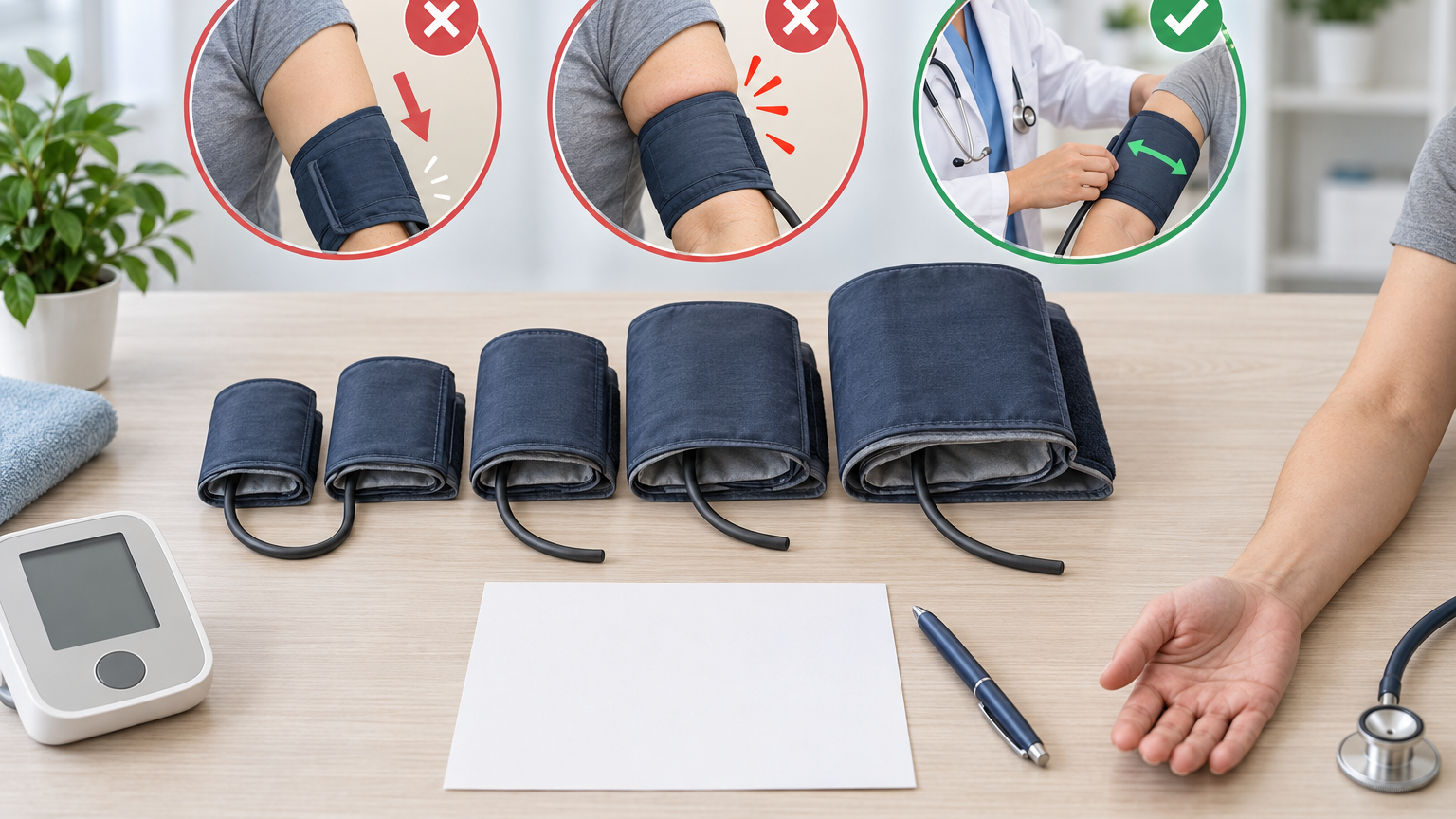
A blood pressure cuff that repeatedly slips, pinches during inflation, or leaves visible marks after measurement may indicate a problem with how it is worn, where it is placed, the cuff size, or accessory compatibility. Do not judge your condition based solely on repeated readings, and do not continue struggling to measure just to get one more reading.
This article offers general device checks and communication tips. It does not replace the device instructions, professional inspection, or individualized medical advice.
Stop Struggling to Measure: How Pinching, Slipping, or Marks Affect the Quality of Records
When the cuff cannot wrap around the arm stably, measurement conditions may be inconsistent. Repeated movement, reinflation, tension from pain, or continuing to measure while the cuff slides can make different readings difficult to compare. A reading on the device does not mean it is reliable, and an error message does not necessarily mean your blood pressure is abnormal.
Pause repeated attempts if any of the following occur:
The cuff slides noticeably toward the elbow or outer upper arm after inflation.
The cuff edge pinches the skin, causing persistent pain, numbness, or skin damage.
The cuff cannot close smoothly, and the Velcro keeps popping open.
The device keeps showing errors, and measurements still cannot be completed after readjusting.
You need extra wrapping, folding, or holding with your hand to keep the cuff in place.
After pausing, let your arm recover comfortably and record what happened. If pain, numbness, swelling, or abnormal skin color does not improve after stopping measurement, contact a healthcare professional for evaluation.
Describe the Problem by Step, and Keep the Device Model and Cuff Label
When asking a pharmacist, nurse, doctor, or device support staff for help, saying "the cuff doesn't fit" is often not enough. Describe the step in the measurement process where the problem occurs. For example, the cuff slides down before inflation, the Velcro comes undone after inflation starts, one side pinches during inflation, or there are unusual marks after the measurement is complete.
Keep the following information to help with checking:
The blood pressure monitor brand, full model, and serial information.
The name, model, size range, and accessory number on the cuff label.
The appearance and connection method of the interface between the cuff and the main unit.
Whether you are measuring the left or right arm, and whether the problem occurs on both sides.
What you were wearing, your sitting posture, arm support, and cuff position at the time.
The full error message shown on the screen, not just "failed."
You can take photos of the device nameplate, cuff label, and interface, but avoid including unnecessary personal information such as name or medical record number.
Check Measurement Position, Arm Circumference Range, and Connection Compatibility Against Device Instructions
First, read the original instructions for that model or the manufacturer's provided materials. Confirm which body part the device is designed for and where the cuff should be placed. Do not use an upper-arm cuff on the wrist, forearm, or other sites unless the device instructions and your healthcare team clearly allow it.
Measure your arm circumference at the location and in the manner specified in the instructions. Use a soft measuring tape, keeping it snug but not tight, and record the value. Then compare that value with the applicable range on the cuff label or in the instructions. Different manufacturers may not use the same size names, so you cannot judge by labels like "small," "standard," or "large" alone.
Even if the size range seems right, continue to check whether the cuff wraps smoothly, the marker line is in the area specified, and the hose, connector, and device model match. Accessories from the same brand may not work with all models. If you cannot confirm, contact the manufacturer's support staff or have a professional inspect it on site.
Operation Observation Table: How to Record Slipping, Errors, Pain, and Raw Readings Separately
The purpose of recording is not to interpret your condition yourself, but to help the healthcare team decide which data are still useful and identify device or operation problems.
Date and time | What happened | Information to keep as is | Follow-up |
|---|---|---|---|
Before measurement | The cuff cannot close smoothly or slides down before inflation | Arm used, arm circumference, cuff model, wearing position | Stop measuring and check instructions |
During inflation | Pinching, Velcro coming undone, cuff moving | Location of pain, whether numbness or skin changes occur | Stop immediately, do not retry continuously |
During measurement | Device shows an error | Full error code or screen text | Record, then check connection and compatibility |
After measurement | Got a reading but wearing process was abnormal | Raw reading, pulse display, details of the abnormality | Mark as measurement conditions questionable, ask healthcare team to judge |
Do not delete readings that look "bad," and do not select, average, or rewrite multiple results on your own. If the device can store records, keep the original timestamps and match the wearing abnormalities with the readings.
What to Bring for On-Site Inspection by a Pharmacist, Nurse, or Device Support Staff
For an on-site inspection, bring the entire device, not just the main unit. Suggestions include:
The blood pressure monitor main unit, power adapter, or batteries.
The cuff you are currently using, the hose, connector, and any adapter parts.
The original instructions, purchase record, or product page information.
Recent operation records and error codes.
Your measured arm circumference and how you measured it.
A list of the medications you are taking, so the healthcare team understands the overall situation.
Ask a professional to observe one complete operation, including sitting posture, arm support, cuff placement, starting the measurement, and recording the result. If a replacement cuff is recommended, confirm the applicable arm circumference, interface, device model, and manufacturer compatibility information. Do not buy just because it looks similar.
Without a Suitable Cuff: Arranging a Temporary Measurement Location with Your Healthcare Team
If you temporarily do not have a confirmed suitable cuff, tell your blood pressure management team as soon as possible. Explain why home measurement cannot be done reliably. You can agree on a temporary measurement location, such as a clinic, pharmacy, or other healthcare facility with appropriate equipment and trained staff. The specific location and frequency should be arranged by your local healthcare team based on your individual situation.
When communicating, explain:
When reliable measurement became impossible.
Whether you are currently adjusting medications or undergoing blood pressure-related follow-up.
Whether you have any new symptoms.
When you expect to get an appropriate cuff.
How temporary measurement results should be reported back.
Do not stop, add, reduce, or change the timing of your medications on your own just because the home device is temporarily unavailable. Medication adjustments must be decided by a professional who knows your personal history and medications.
Abnormal Readings with Severe Symptoms That Cannot Wait for Device Issues
If an abnormal reading is accompanied by severe chest discomfort, significant shortness of breath, fainting, sudden weakness in a limb, sudden difficulty speaking, changes in consciousness, or other rapidly worsening severe symptoms, do not focus only on whether the cuff fits. Do not delay seeking help by measuring repeatedly. Contact local emergency services or go to the emergency room immediately for professional evaluation.
Even without reliable home readings, severe or sudden symptoms themselves may require emergency treatment. Conversely, a single abnormal reading cannot be used to determine the cause or diagnose on its own. If the reading is far outside the range your healthcare team set for you, but you have no severe symptoms, follow your established follow-up plan. If there is no plan, consult a professional as soon as possible.
Warning Boundaries: Modifying the Cuff or Using Unconfirmed Accessories May Make Readings Useless
Do not cut, extend, fold, or additionally wrap the cuff. Do not use tape, pins, or other items to force it to stay in place. Even if unconfirmed hoses, adapters, or third-party cuffs can be connected, that does not mean their measurement performance matches your device.
The following actions require clear confirmation from the device manufacturer or a healthcare professional first:
Using a cuff from a different brand or model.
Adding extra straps to the original cuff.
Measuring on the forearm, wrist, or other locations.
Using accessories without clear model and applicable range markings.
Using someone else's cuff size for yourself.
Until the device fit issue is resolved, clearly mark data from questionable measurement conditions. Do not use such data to change treatment on your own, and do not treat illustrative images or online experiences as proof of compatibility.
Final Action: Get an Appropriate Solution and Complete One Supervised Comparison Measurement with the Same Process
The ultimate goal is not just to buy a "larger" or "smaller" cuff. It is to confirm that the measurement site, arm circumference range, interface, and device model all match. After getting an appropriate solution, it is best to have a pharmacist, nurse, doctor, or qualified device support staff guide you through one measurement. Confirm that the cuff remains stable throughout, there is no unusual pain, and the device completes the operation normally.
After that, continue using the same body location, cuff, posture, and recording method to improve comparability of results. If the problem occurs again, keep the original records and recheck the device. Do not modify it on your own just to keep using it.
An ill-fitting blood pressure cuff is first a measurement quality issue that needs to be verified. Pausing struggling measurements, saving device information, seeking on-site inspection, and arranging reliable temporary measurement can help the healthcare team get more meaningful information. It also reduces the risk of misjudgment caused by wrong accessories or abnormal operation.
Medical Health FAQ
1. Before consulting the Heart Alliance, how should a person with high blood pressure or coronary artery disease concerns and worries about family history related to their own condition organize information?
You can write down which relatives were told by healthcare providers what diseases they had, their approximate age at onset, and whether this information is supported by their own statements or medical records. Mark anything you are unsure about as unknown. Do not speculate, and do not delay your appointment just to gather complete data. Talk with the doctor at the Heart Alliance about the questions you want answered. Do not assume you will get the same disease just because a relative had it.