Tracking Fluids When Your Heart Team Sets a Limit
Review date: 2026-10-13 · Credential: 110330000703903
Abstract
Tracking Fluids When Your Heart Team Sets a Limit
Tracking Fluids When Your Heart Team Sets a Limit
If your care team has already told you to limit fluids, your daily log needs to answer three questions: what counts, how much you actually consume, and which amounts are estimates. Keeping this information in one log makes it easier to check your entries and ask your team to identify anything you missed at follow-up visits.
This article offers general tracking methods. It does not determine whether you need a fluid limit or set a daily intake amount. Follow your treating team's personalized instructions for your total allowance, what counts toward it, and how long to follow the limit.
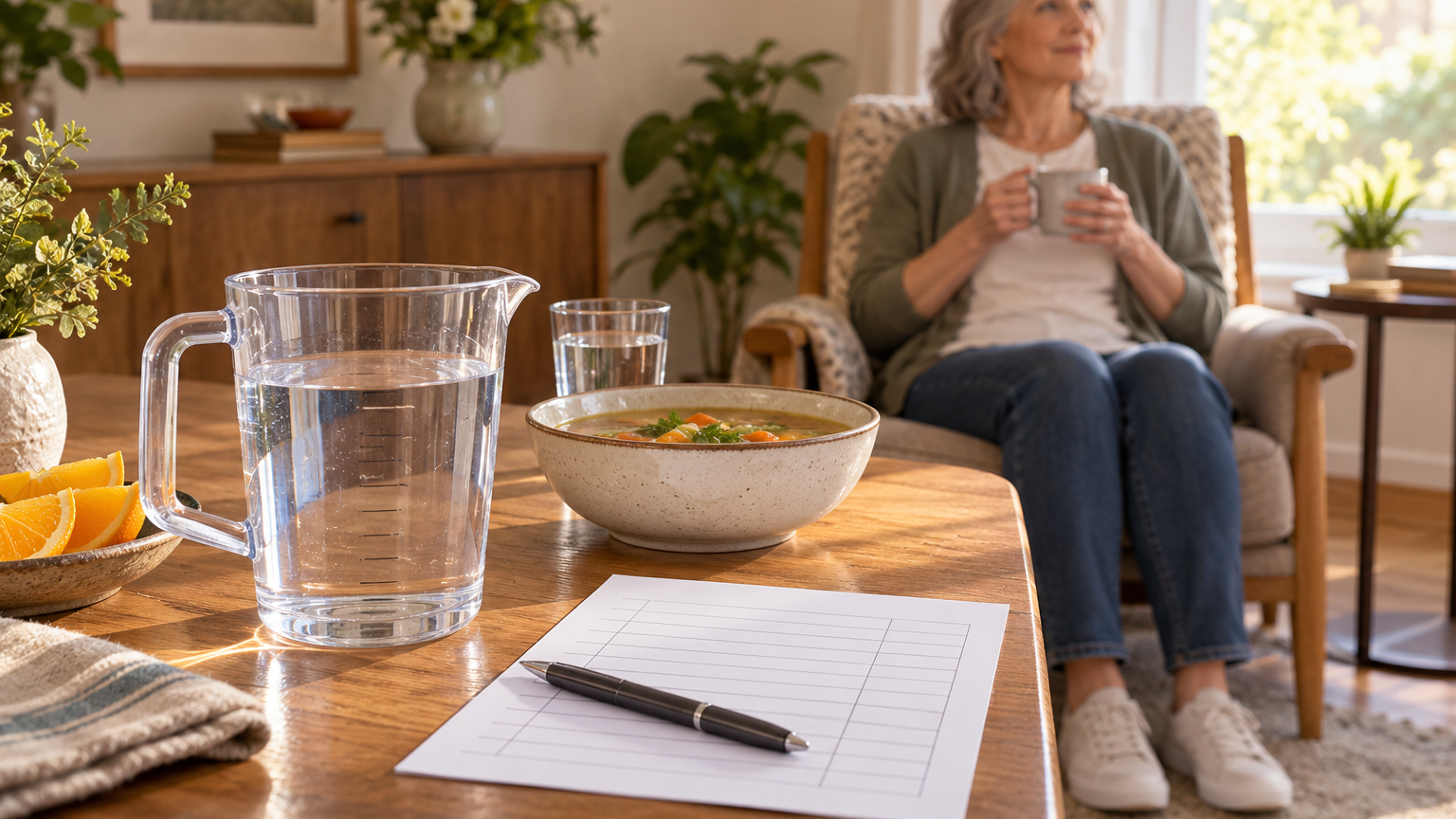
The image helps illustrate fluid tracking. It does not represent clinical evidence or a personal treatment plan.
First, Confirm the Written Total, What Counts, and How Long the Limit Applies
Before you start tracking, write your doctor's instructions at the top of your log. Simply being told to "drink less water" does not provide a clear basis for calculating intake. Ask your care team to help fill in the following details:
The total amount allowed during each tracking period and the unit of measurement.
What time each "day" starts and ends.
Which drinks, foods, or other sources of intake count toward the limit.
When to start and when the limit will be reviewed or reassessed.
Who to contact with questions or if you feel unwell, and how to reach them.
Use milliliters consistently whenever possible instead of mixing "one cup," "half a bowl," and milliliters. If different documents give conflicting instructions, ask your team to review them and keep one clear version. Do not choose a number yourself or use a general limit you find online as your personal instruction.
Identify Soups, Drinks, and Other Items That Are Easy to Miss
When checking your intake, think through your meals and drinks in order: what you drank after waking up, whether you had a beverage with breakfast, whether lunch or dinner included soup, whether you took medication with water, and whether you consumed anything during the night.
Along with plain water, add tea, coffee, milk, juice, soup, and similar items to your checklist, then count them according to the scope your care team has confirmed. Specifically ask about and record water used to take medication so it does not get overlooked just because each amount is small.
Ask your team how to count ice, foods that become liquid when they melt, and foods that combine solids and liquids, such as rice porridge. Do not apply the same conversion ratio to different foods on your own. If you do not have a clear method, record the item's name, portion size, and what you are unsure about, then add details after checking with your team.
This checklist helps you spot omissions. It does not mean every reader should count exactly the same items.
How to Measure the Capacity of Cups and Bowls You Use at Home
"One cup" is not a fixed amount. If you change containers or fill them to different levels, entries that both say "one cup" may represent different amounts consumed.
Choose the water glasses, teacups, and soup bowls you use most often, and measure each with a measuring cup marked in milliliters. Along with the container's full capacity, record the amount it holds at your usual fill level. For example, mark the spot you usually fill to on the outside of the cup and write down the number of milliliters at that level.
If you do not have a marked measuring tool, you can temporarily use packaging with a clearly labeled volume as a reference, but note that the amount is an estimate. A bottle's label gives the volume of the entire bottle. If you drink only part of it, you cannot record the full bottle's volume as your intake.
Your log should reflect what you actually drink. Consider the amount poured, any refills, and what is left over together.
Record Each Intake in One Log Instead of Relying on Memory
You can use paper, a notes app on your phone, or another tracking tool. The key is to use the same log throughout the day. If family members help, have them write in the same place whenever possible to avoid recording the same glass of water twice.
Each entry can include four details: the time, the item, the amount actually consumed, and how it was measured or estimated. Recording it soon after you finish drinking makes it easier to check than trying to recall everything at bedtime.
The following hypothetical entries demonstrate the calculation only. They are not recommended drinking amounts:
8:00 a.m., plain water: 150 milliliters poured, 30 milliliters left over, 120 milliliters actually consumed.
9:30 a.m., tea: 100 milliliters actually consumed, recorded using the mark on the cup.
12:00 p.m., soup: about 80 milliliters, estimated using a small bowl whose capacity has been measured.
If all of these items count toward your personal limit, the subtotal is 120 plus 100 plus 80, or about 300 milliliters. Because one entry is an estimate, the total should also say "about." It should not be presented as an exact measurement.
Add a new entry for each refill, or clearly add it to the original entry. If you forget to record an intake, do not invent an exact number. You can write "amount not recorded; needs checking."
How to Note Estimates and Uncertainty When Sharing Meals or Eating Out
When eating out, you may not be able to determine a container's exact capacity. Keep as much information as you can that could help verify the amount, such as the volume on the packaging, the type of cup, the number of refills, and roughly how much of the drink you finished.
For soup at a shared meal, you could write "about half of a small bowl of the same type." If you have not measured that bowl, also note "capacity unknown." Do not use the volume of a container at home just because the restaurant's container looks similar.
For items you cannot reliably convert to a volume, you can list these separately:
Measured intake.
Estimates with a clear basis.
Items that cannot yet be converted, with descriptions of their portions.
For example, "about 700 milliliters recorded, plus half a bowl of restaurant soup that could not be estimated" is more complete than simply writing "700 milliliters for the day." These numbers only demonstrate how to write an entry. They do not represent a suitable daily target for anyone.
Who to Ask About Adjustments When You Are Thirsty, the Weather Changes, or You Feel Unwell
If you experience significant thirst, hot weather, increased activity, fever, vomiting, or diarrhea, share when it started, how long it has lasted, and your intake log for that day with your treating team. Ask whether your current limit needs to change.
When contacting them, you can say: "My written daily limit is this amount, I have recorded this much so far, and this is what changed today. How should I follow the instructions from here?" This makes your question more specific.
Do not change medication doses based on your remaining fluid allowance or skip necessary medication to reduce the milliliters in your log. If you have questions about the water needed to take medication or other medication instructions, check with your doctor or pharmacist.
If you develop warning signs such as severe difficulty breathing, persistent chest pain, fainting, or changes in awareness, contact local emergency services immediately. Do not wait to finish your log or receive a routine follow-up response.
General Tracking Methods Cannot Determine Whether You Need a Fluid Limit
A tracking tool only organizes your intake information. It cannot assess your condition or determine whether to start, tighten, or stop a fluid limit. Having heart disease does not mean you can use any of this article's example amounts as your own limit.
Likewise, recording less than your allowed amount on a particular day does not mean that less is always better. If you exceed your limit, do not create your own plan to "make up for it" by drinking less the next day. Keep an accurate record and ask your team what to do.
This article does not present research findings supporting a specific fluid limit or treatment outcome. These practical methods are intended for people who already have personalized instructions and need to organize their daily intake information. They cannot replace an assessment of an individual's condition.
Ask Your Care Team to Review a Full Day's Log and Correct Omissions
At your next follow-up visit, bring a complete daily log, your current written instructions, and notes on the capacities of your usual cups and bowls. Also note any restaurant meals, missed entries, or symptoms that day.
Ask your team to check whether you are counting the right items, whether you missed water taken with medication or refills, whether you subtracted leftovers, whether your method for counting foods with both solids and liquids is appropriate, and how to handle estimates. You can also confirm that your tracking period matches their instructions.
After the review, write the corrected methods at the top of your log and include the date they were confirmed. If the daily total or counting rules change, record when the change took effect so you do not mix old and new instructions. A log that accurately reflects actual intake and uncertainty is more useful for communication than a total that only appears precise.
Frequently Asked Health Questions
1. During a High Blood Pressure Follow-Up at Heart Alliance, How Should I Tell My Doctor About Missed Doses or Stopping Medication on My Own?
Tell your doctor exactly which medications you missed or stopped, the specific dates, how long it lasted, why it happened, and your blood pressure readings and how you felt during that time. Do not hide details to make your medical record look better. The prescribing doctor must decide whether to restart medication or change the plan. Never take a double dose at once on your own to make up for missed medication. If you also feel noticeably unwell, contact Heart Alliance or a nearby medical facility as soon as possible.