Track Dizziness and Blood Pressure
Review date: 2026-09-23 · Credential: 110*********650
Abstract
Track Dizziness and Blood Pressure
Track Dizziness and Blood Pressure
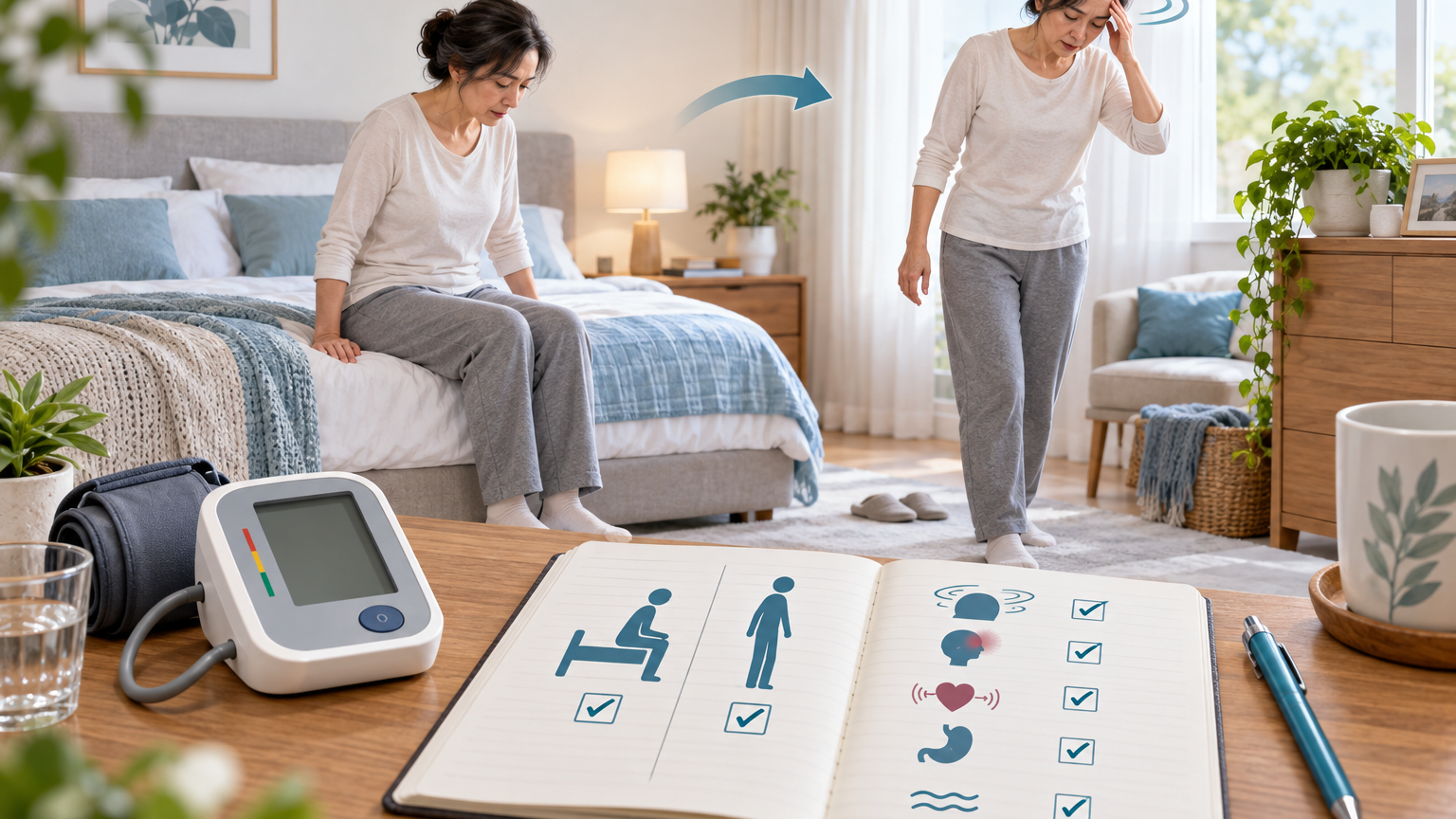
Repeated dizziness when getting up from lying or sitting may show up as vision going dark, unsteadiness, a floating sensation, nausea, palpitations, or feeling close to fainting. A single home record cannot pin down the cause, but putting posture changes, symptom order, blood pressure, and pulse readings on the same timeline helps medical staff understand the real situation where symptoms occur.
The point of recording is not to chase some standard answer but to faithfully keep what happened, when it happened, how long it lasted, and what other conditions were present at the time. If measuring raises the risk of falls or fainting, safety comes first; do not force yourself to stand just to complete a record.
Safety first: seek help promptly for fainting, falls, or severe associated symptoms
When dizziness appears, stop walking or any other activity that could cause injury immediately and sit or lie down in a safe place. Do not keep measuring alone on stairs, in the bathroom, on a balcony, or near traffic, and do not drive while dizziness has not eased.
Contact local emergency services or medical professionals promptly if any of the following occur:
You have already fainted, fallen, or been injured
Chest pain, chest pressure, or obvious difficulty breathing
New one-sided limb weakness, facial drooping, slurred speech, or abnormal consciousness
Persistent or clearly worsening palpitations with near-fainting, chest discomfort, or shortness of breath
Sudden severe headache, seizures, or symptoms clearly different from before
Inability to stand safely, or repeated near-fainting within a short time
If the person is unconscious, do not force water, medication, or standing. Even if symptoms later ease, tell medical staff about any fainting, falls, or severe associated symptoms.
Distinguish descriptions of dizziness on standing, ongoing vertigo, and simple fatigue
"Dizziness" can mean different feelings. When recording, do not try to diagnose the condition yourself; use language as close to the actual experience as possible.
Discomfort related to getting up: appears after moving from lying to sitting or from sitting to standing, and may ease after sitting or lying back down
Spinning sensation: feeling that you or the surroundings are rotating, possibly with nausea or unsteady gait
Floating or unsteadiness: no clear spinning, but feeling unsteady on your feet or hollow in the body
Vision going dark: field of vision darkening, blurring, or brief blackout
Near-fainting: feeling about to lose consciousness, but still able to respond at the time
Fatigue or drowsiness: mainly weakness, sleepiness, or reduced endurance, not necessarily closely tied to posture changes
Also note whether symptoms appear only when getting up, whether they also occur while sitting or lying down, and whether turning the head, walking, bowel movements, bathing, or activity makes them more obvious. Describing differences is more useful for later assessment than just writing "dizzy today."
Record the order of symptom onset and relief from lying, sitting up, to standing
A complete record can be written in the actual order of events:
Record the date, time, and environment.
Note whether you were lying or sitting before getting up, and roughly how long.
Record the specific process from lying to sitting up and from sitting to standing; do not get up quickly just to match the record.
Write down at which stage symptoms first appeared: when sitting up, just after standing, or after standing for a while.
Record the most prominent feeling, severity, and associated symptoms.
Note what safety measures you took, such as sitting down, lying down, or being helped by someone.
Record when symptoms began to ease, whether they completely disappeared, and whether you could walk safely afterward.
If any step already causes obvious dizziness, vision darkening, or unsteadiness, stop standing. Not completing all steps is also real and valuable information.
Keep blood pressure, pulse, time, and measurement conditions according to existing device instructions
When using a home blood pressure monitor, follow the device manual and any measurement requirements already given by medical staff. Record the blood pressure, pulse, and measurement time shown by the device, and note the posture at that time. Do not keep only the lowest or highest reading, and do not repeat measurements until you are satisfied because a reading is "not ideal."
Measurement conditions also affect how readings can be interpreted. You can record together:
Which arm was used, cuff position, and whether cuff size is appropriate
Whether you were lying, sitting, or standing during measurement
Whether you were talking, moving, shivering, or needing help from someone
Whether the device showed an error, or whether the reading was interrupted by movement
Whether you had just eaten, bathed, exercised, consumed caffeinated drinks, or smoked before or after measurement
Whether there was pain, anxiety, fever, vomiting, or diarrhea at the time
A single home reading may be affected by the device, posture, and measurement conditions. Do not judge the cause based on one blood pressure or pulse reading alone, and do not increase, decrease, stop, or supplement medication on your own because of a certain number.
Two-column record table: how body sensations and device readings correspond one-to-one
Treat each posture change as a separate row so that subjective feelings and device readings are at the same time point. If no safe reading was obtained, write "not measured" truthfully; do not estimate.
Body sensations and situation at the time | Device readings and measurement conditions |
|---|---|
Date and time; lying, sitting up, or standing; when symptoms appeared; specific feeling; whether palpitations, nausea, chest discomfort, or shortness of breath; how long it lasted; how it eased | Blood pressure; pulse; measurement time; measurement posture; arm and device used; whether moving, talking, needing help, or device error |
Example: In the morning after waking, from lying to sitting up, a floating sensation appeared, worsened after standing, sat back on the bed immediately, then gradually eased | Fill in according to the device's actual display; if not measured due to unsteadiness, note "standing reading not taken to avoid falling" |
Symptom severity can use descriptions you can consistently apply, such as mild, moderate, severe, or a fixed number scale. The key is consistency over time, not comparing grades between different people.
Include eating, drinking, weather, activity, and actual medication times as background
The same act of getting up can occur in different contexts. Recording these backgrounds helps medical staff look for time associations, but occurring together in time does not prove a cause-and-effect relationship.
Suggested additions:
Time and general details of the last meal
Fluid intake that day, and whether there was vomiting, diarrhea, or heavy sweating
Whether the weather was hot, and whether you were in a stuffy environment for a long time
Whether before the episode you had been sitting or lying for a long time, taken a hot bath, exercised, or stood for a long time
Actual medication times that day, not just copying the planned times from the prescription
Whether any dose was missed, delayed, or taken incorrectly; if so, record truthfully, and do not make up doses on your own
Whether you drank alcohol, or used any newly added prescription drugs, over-the-counter drugs, or supplements
Lack of sleep, infection discomfort, pain, or emotional stress
When recording medications, write the generic name or the full name on the package, dose, actual time taken, and method. If unsure, take a clear photo of the pill box and label for review at the appointment, but do not treat internet search results as your own medication plan.
What device information, medication list, and fall records to bring to the appointment
Before the appointment, prepare a short set of materials, including:
Consecutive raw records, not just selected abnormal readings
Blood pressure monitor brand, model, cuff size, and device age
Prescription drugs, over-the-counter drugs, and supplements, including actual times taken
When symptoms first appeared, recent frequency, and whether they are gradually changing
Dates and details of fainting, near-fainting, falls, and injuries
Known past illnesses, recent infections, vomiting, diarrhea, or changes in food and fluid intake
Questions you want to confirm with medical staff
If possible, bring the home blood pressure monitor to the appointment and ask whether the device and measurement method are suitable for continued use. Whether further tests are needed should be judged by professional medical staff based on medical history, physical examination, and other information.
Verification boundary: home posture records cannot self-diagnose causes or guide medication changes
Dizziness on standing does not correspond to a single cause. Home records can show associations between symptoms and posture, time, and readings, but cannot confirm the cause alone, nor rule out cardiovascular, neurological, ear, metabolic, medication-related, or other problems.
Changes in blood pressure or pulse need to be interpreted with symptoms, measurement quality, past health status, and medication use. Home devices may also be affected by inappropriate cuff size, movement, heart rhythm changes, or operating method. Therefore, do not self-diagnose so-called "low blood pressure" or other conditions based on self-made records, and do not adjust antihypertensive drugs, diuretics, heart-related drugs, or other prescription drugs on your own.
If you suspect a medication is related to symptoms, record actual medication use and episode times, and contact the prescribing doctor or pharmacist to check. Suddenly stopping, double-dosing, or changing doses can be risky.
Final action: complete several real-scenario records and confirm evaluation channels
Next, without increasing risk, record several naturally occurring getting-up scenarios. Use the same format each time, keeping posture, symptoms, time, blood pressure, pulse, measurement conditions, and related background. Do not deliberately induce dizziness repeatedly, and do not continue testing when alone, unsteady, or already near fainting.
Also confirm the evaluation channels you can contact, such as your regular doctor, cardiovascular specialist, or local medical services. If symptoms recur, worsen, affect walking, or come with palpitations, chest discomfort, shortness of breath, fainting, or falls, seek professional evaluation promptly. If emergency danger signals appear, contact local emergency personnel immediately.
The purpose of these records is to make communication at the appointment more complete, not to replace diagnosis, prescription, or individualized treatment advice.