Restart Routine Heart Screening
Review date: 2026-09-17 · Credential: 1101*********81
Abstract
Restart Routine Heart Screening
Restart Routine Heart Screening
Not having your blood pressure, cholesterol, or basic health checks for years does not mean you already have a disease, and you can't rule out risks just because you feel fine right now. When starting again, the point is not to cram in as many tests as possible all at once, but to first gather past records, explain your personal risk background, and then work with your healthcare team to decide which tests are right for you, in what order, and when to repeat them.
This article provides ideas for preparing for appointments and managing schedules. It does not diagnose or dictate which tests anyone must have. The specific tests and frequency depend on your age, past results, medical history, medications, and other risk factors, and should be assessed by a medical professional.
First, list the reasons you stopped: time, cost, transportation, or thinking no symptoms means no need to check
Long gaps in screening are rarely due to one reason. Inconvenient appointment times, transportation problems, cost concerns, moving, or switching clinics can all cause repeated delays. Some people think that because they don't have chest pain, dizziness, or other symptoms, they don't need blood pressure or cholesterol checks.
Before scheduling, write down the main obstacles that kept you from follow-up. This helps you discuss realistic arrangements with the clinic, such as whether the consultation and sample collection can be on the same day, whether fasting is needed, whether some tests can be done at a facility closer to home, and how you'll get the results.
If cost is the main barrier, ask about what's included, payment options, and any extra charges before the test. Don't keep putting off basic assessment because you're worried about having to do everything at once.
Find the dates of your last blood pressure, cholesterol, blood sugar, and checkup
Try to retrieve the following from past medical records, exam reports, electronic health records, pill boxes, prescriptions, or home blood pressure logs:
Date, reading, and setting of your last blood pressure measurement.
Date and full report of your last cholesterol test.
Date of your last blood sugar test and other health check items.
Whether you were sick, in pain, sleep-deprived, or adjusting medications at the time.
Whether any healthcare provider recommended follow-up and whether you completed it.
If you can't find old records, don't delay your appointment. Tell the team that records are missing, roughly how long the gap has been, and whether you were ever told results were abnormal. Don't fill in numbers from memory, and don't use family members' results as your own.
Home blood pressure readings can add information, but a single reading or an unverified device log can't replace professional assessment. If you plan to measure at home, ask the team about the device, cuff size, technique, timing, and how many days to record.
Distinguish between routine screening, symptom evaluation, and follow-up for existing conditions
These three reasons for seeing a doctor are not interchangeable.
Routine screening is for people without a related diagnosis and no current acute symptoms, to understand baseline risk and decide if further evaluation is needed. Symptom evaluation is for new or worsening discomfort; the tests and urgency depend on the symptoms. People with known high blood pressure, abnormal cholesterol, diabetes, coronary artery disease, or other cardiovascular conditions usually need disease follow-up, not just re-entering general screening.
When making the appointment, say clearly which situation you're in. If you have a past diagnosis, are on medication, have stopped medication, or were advised to have further tests, tell the staff. Don't restart, stop, or change prescription doses on your own to prepare for tests; if unsure about medication before sampling, ask the prescriber or testing facility in advance.
Initial visit information checklist: age background, family history, smoking, diseases, and medications
An effective review of your baseline risk needs more than just test dates. Before the visit, gather:
Age and key health background.
Whether parents or siblings have cardiovascular disease and approximate age of onset; note unknown if unsure.
Current and past smoking or other tobacco use.
Known diseases, past surgeries, allergies, and important test results.
Names, doses, and frequency of all prescription, over-the-counter, and supplement medications.
Pregnancy, trying to conceive, kidney or liver disease, or other conditions that might affect test interpretation or management.
Recent symptoms, when they started, how long they last, and triggers.
Bring original reports or verifiable electronic records. For medications you can't remember, bring the pill box or a photo, but cover any personal information unrelated to the visit.
Confirm with your healthcare team which tests apply and how frequency is decided
Not everyone needs the same tests, and you shouldn't schedule them just based on age milestones from the internet. The team may discuss blood pressure measurement, cholesterol or blood sugar tests, and decide if other assessments are needed. Whether to test, when to repeat, and whether to refer depend on past results and current risk.
At the visit, confirm for each item:
What question this test answers.
Which tests apply now and which don't.
Whether fasting or timing adjustments are needed.
How to handle daily medications on test day.
What results would require retesting, further evaluation, or earlier contact with the team.
How to determine the next review date if results are normal.
Test results need to be interpreted in your personal context. A single value can be affected by measurement conditions, but don't ignore abnormal results on your own. Whether retesting or further action is needed should be decided by a professional with the full picture.
Schedule: who handles appointment, sample prep, result pickup, and explanation
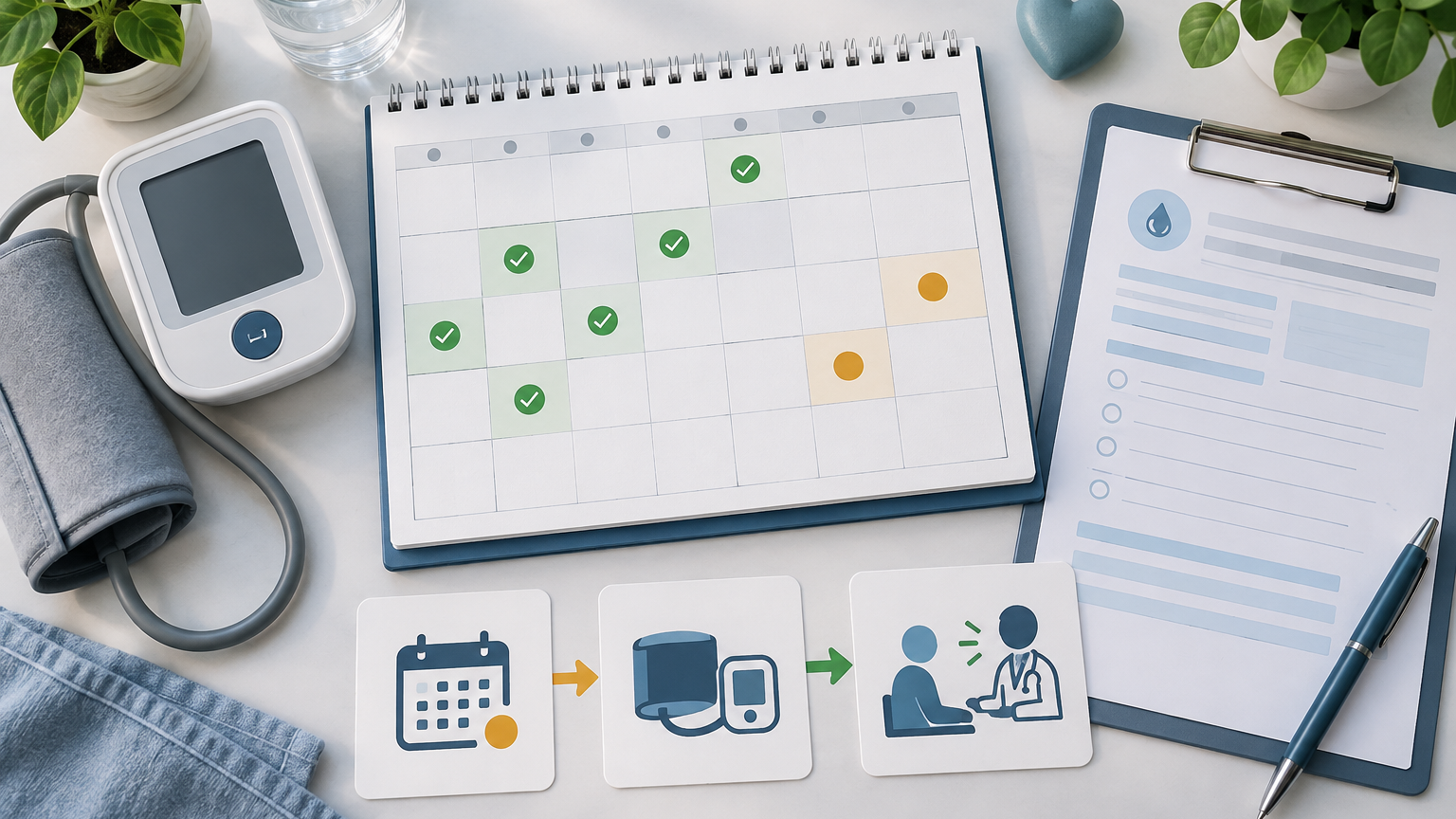
When restarting screening, include everything before and after the test. Use a short schedule table with responsible party and status.
Step | What to confirm when scheduling | What to record |
|---|---|---|
Initial appointment | Purpose of visit, past diagnoses, current symptoms | Date, location, department |
Test preparation | Fasting, medication instructions, documents to bring | Original instructions from facility |
Measurement or sampling | Test names, where done, any unfinished items | Actual completion date |
Result pickup | How results are delivered, when available | Check date and contact info |
Result explanation | Who explains, whether retest or referral needed | Discussion date and next steps |
Follow-up reminder | How next visit is determined | Reminder date and responsible person |
Don't think seeing a report is the same as completing follow-up. Set a date to discuss results before the test to avoid reports going unexplained or abnormal results sitting around. If the facility doesn't provide results by the agreed time, follow up through their designated channel.
Why you should not wait for a screening appointment if you have chest discomfort, significant shortness of breath, or fainting
Routine screening appointments are not for symptoms that may need urgent evaluation. New or worsening chest discomfort, significant shortness of breath, or fainting, especially with cold sweats, severe weakness, altered consciousness, or symptoms that don't improve, should not wait for a screening appointment days or weeks later.
In such cases, contact local emergency services or get professional medical evaluation promptly, and don't drive yourself. The cause of symptoms cannot be determined by appearance alone, and you shouldn't use home blood pressure, smart device data, or online information to rule out serious problems.
If symptoms have resolved, still tell a professional the timing, duration, associated symptoms, and activity at the time, and let them decide the urgency of further evaluation.
Verification boundary: generic age milestones cannot replace individual risk assessment
Generic screening recommendations are for population-level health management and cannot fully cover everyone's medical history, family history, past abnormal results, and medications. Starting ages and intervals for different tests may change based on your background.
So when you see a checklist by age, treat it as a starting point for discussion with your team, not a personal diagnosis or fixed prescription. People with existing conditions, past abnormal results, ongoing treatment, or symptoms often need arrangements different from the general population.
Also, more tests are not necessarily better. Tests without clear indication may bring extra costs, incidental findings, and downstream burdens. The sensible approach is to first clarify your questions, then choose assessments that answer them.
Final action: schedule a basic risk review and set a date to discuss results
If you haven't been checked in years, take one specific limited action: schedule a basic cardiovascular risk review. When booking, say how long the gap has been, whether you've had abnormal results, whether you're on medication, and whether you have symptoms.
Then do three things: bring any old records and a medication list; prepare for measurement or sampling as instructed by the facility; before leaving, confirm who will explain results and when.
The goal of this review is not to solve everything at once, but to establish a sustainable follow-up plan. The final schedule should list next steps, responsible people, result discussion date, and the basis for the next visit. If your condition, symptoms, or medications change, contact the team promptly for reassessment instead of waiting for the original date.
This article is for general medical education only and does not replace a doctor's diagnosis, prescription, or individualized treatment advice.
Medical health FAQ
1. If I see genetic testing for high blood pressure or coronary heart disease advertised on the Heart Alliance platform, how do I assess whether it's worth discussing with my doctor?
Provide your doctor with the specific test name, claimed purpose, cost, and a sample report. Key questions to ask include what clinical question the test answers, whether the results would change your current management, and how to interpret uncertain results. Also confirm the testing company's qualifications, privacy protections, and availability of genetic counseling. Don't treat promotional risk descriptions as a personal diagnosis, and never change treatment based solely on test results.
2. For Heart Alliance users with high blood pressure or coronary heart disease who want to lose weight, how can they prepare for a targeted consultation?
Record your recent weight fluctuations, daily diet, physical activity, past weight loss attempts, and specific barriers. At the visit, tell the doctor what you most want to improve, ask if a dietitian referral is needed, and how to set realistic goals and follow-up plans. Don't follow internet fad diets or take any weight loss drugs on your own.
3. If Heart Alliance patients with high blood pressure or coronary heart disease want to express their future medical care wishes in advance, where should they start?
First, clarify your life goals, acceptable forms of care, people you want involved in communication, and emergency contacts. Then schedule an appointment with your long-term doctor to learn about local processes for advance care planning, healthcare proxies, and document storage. Involve a medical social worker or qualified legal professional if needed. These documents need regular review and make sure designated family members and medical facilities know where they are stored.
}