Reduce Nighttime Light for Heart-Safe Sleep
Review date: 2026-09-14 · Credential: 2011**********72
Abstract
Reduce Nighttime Light for Heart-Safe Sleep
Reduce Nighttime Light for Heart-Safe Sleep
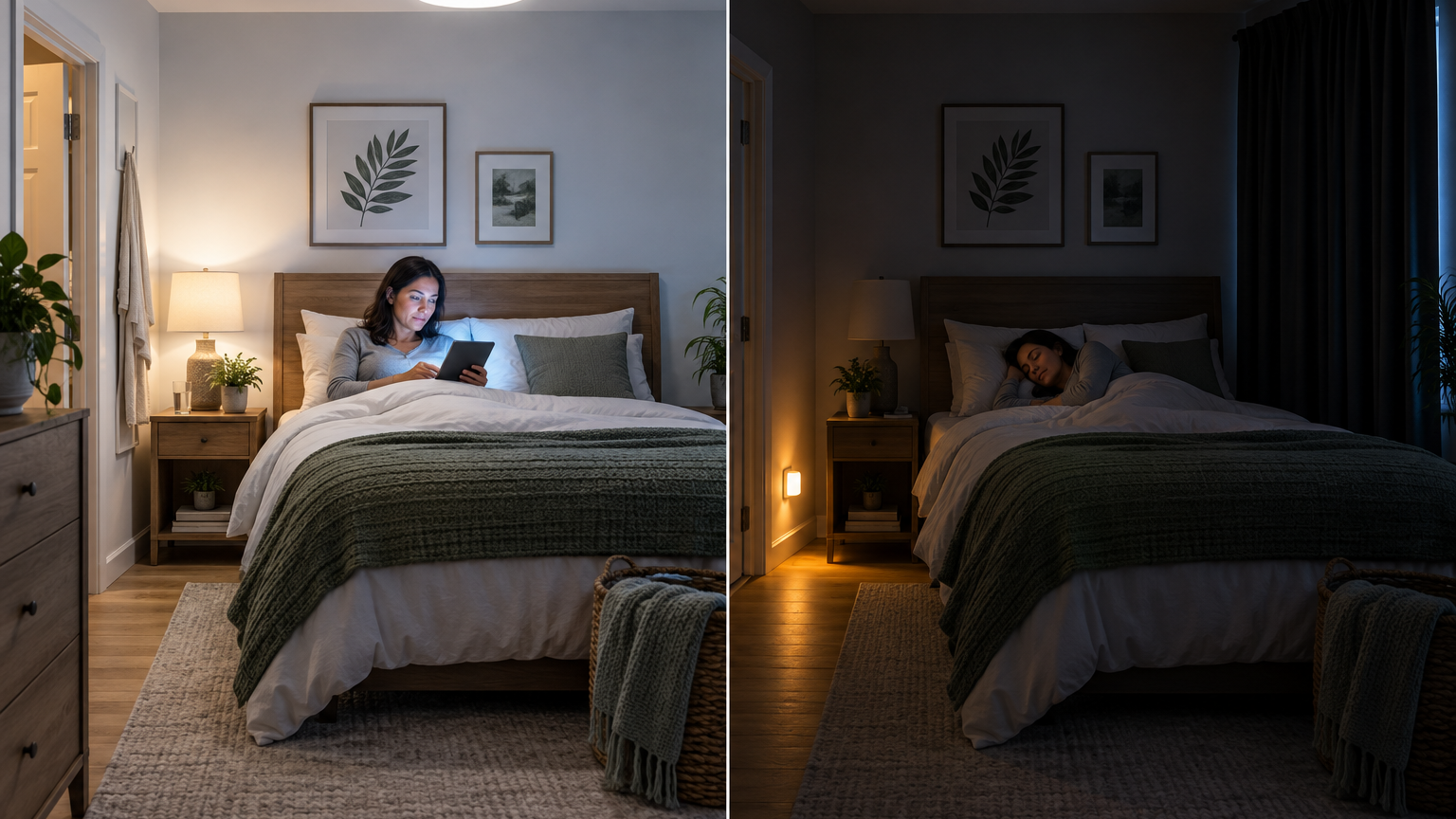
Some people are used to sleeping with a light on, while others are affected by hallway lights, electronic devices, or outdoor lighting. If you want to reduce nighttime light in the bedroom, the key is not to pursue absolute darkness, but to gradually reduce unnecessary light without affecting nighttime mobility, caregiving, and medication safety.
Caption: A bedroom nighttime light reduction diagram, intended only to help organize environmental adjustment ideas. It cannot be used as clinical evidence to judge an individual's heart risk.
First distinguish between nighttime light research and personal heart risk judgment
The relationship between nighttime light and sleep, circadian rhythms, and cardiovascular health still needs to be understood in the context of study design, study populations, and exposure measurement methods. Observing that two conditions occur together does not prove that one directly causes the other.
For an individual, whether or not to leave a light on cannot be used to diagnose heart disease, nor to determine that a cardiovascular event will definitely occur in the future. Age, previous diseases, medications, sleep problems, shift work, activity level, and other lifestyle factors can all affect health status.
Therefore, reducing bedroom light is suitable as an adjustable sleep environment management measure, not as a treatment for heart disease. People with diagnosed cardiovascular disease should not stop medications, change medications, or delay follow-up appointments because of adjusting lights.
Use three nights of recording to find out where the light comes from and how long it lasts
Before making changes, record for three consecutive nights. The recording does not need to precisely measure illuminance; the goal is to identify the most easily manageable light sources.
Each night, write down:
Bedtime, lights-off time, and approximate time falling asleep
Which lights or screens were used before sleep
Which light sources persisted throughout the night
Number of nighttime awakenings and times lights were turned on
Whether morning light woke you up early
Whether you needed to take medication, use the bathroom, or care for someone at night
Whether you experienced drowsiness, dizziness, or decreased concentration the next day
Do not draw conclusions based on just one night. Short-term fluctuations may coincide with noise, emotions, diet, physical discomfort, or schedule changes. When reviewing after a week, focus on whether adjustments are easy to maintain and whether they introduced new risks such as falls or missed medications.
Distinguish between pre-sleep lighting, all-night lights, and early morning light
Light at different times requires different approaches.
Pre-sleep lighting mainly comes from ceiling lights, bedside lamps, and devices such as phones. You can first shorten the time of bright light use, retaining the lighting needed for washing, reading, and taking medication.
All-night lights may come from night lights, hallways, device indicator lights, or outside. You can first turn off light sources with no practical use, and cover small indicator lights that do not affect device status recognition. Do not cover ventilation openings, alarm lights, or necessary display areas of medical devices.
Early morning light is usually related to curtain gaps, seasonal changes, or outdoor lighting. You can adjust the bed position or curtain blackout level, but after getting up you should still return to a normal activity environment and avoid staying in a dim space all day.
Bedroom inventory: ceiling lights, bedside lamps, screens, and outdoor light sources
Check the bedroom in a fixed order to reduce omissions:
Ceiling lights: confirm whether they remain at high brightness before sleep, and whether the switch is easy to operate from the bed.
Bedside lamps: check whether the light shines directly into the eyes, and whether reading or taking medication can be done at a lower brightness.
Screens: check whether phones, tablets, TVs, and clock displays remain lit, and whether notifications repeatedly light up the screen.
Indicator lights: confirm whether the lights on chargers, routers, and appliances are truly necessary.
Light from outside the door: observe whether hallway light enters through the door gap, and confirm that closing the door meets ventilation, caregiving, and fire safety requirements.
Outdoor light sources: check curtain edges for light leakage before sleep and in the morning.
Medical devices: do not turn off, cover, or move monitoring, respiratory support, or other medical devices in use without authorization.
Step-by-step adjustment checklist: reduce brightness, shorten duration, and block light sources
Light reduction can be done in three steps, changing only one thing at a time to judge whether it suits you.
Step one is to reduce brightness. Replace high-brightness ceiling lights with lower brightness lighting that meets activity needs, adjust lamp positions, and avoid light shining directly on the bed and eyes.
Step two is to shorten duration. After finishing washing, reading, or taking medication, turn off lights that are no longer needed. To reduce repeated checking of the phone, set Do Not Disturb mode in advance, but keep necessary call alerts from family, caregivers, or medical contacts.
Step three is to block light sources. Deal with curtain gaps or small indicator lights that do not need to be seen. Eye masks are only suitable for people who can remove them on their own and will not affect nighttime mobility or medical care; if discomfort occurs, stop using them immediately.
During the adjustment process, avoid:
Removing nighttime pathway lighting to pursue total darkness
Suddenly turning off all lights in unfamiliar environments
Covering smoke alarms or medical device alerts
Allowing wires, blackout materials, or lamps to obstruct pathways
Reducing necessary nighttime medication, monitoring, or caregiving due to concerns about light
How to prioritize nighttime mobility, caregiving, and fall risk
Nighttime safety takes priority over complete light reduction. Older adults, people with limited vision, those who have recently fallen, and those taking medications that may cause dizziness or drowsiness need to retain clear, stable walking lighting.
Place low-brightness lighting near the path from bed to bathroom so that the floor, thresholds, and obstacles are visible, while avoiding light shining directly at the head of the bed. Switches should be within easy reach, not requiring a person to walk in the dark before turning on a light. Motion-sensor lights need to be tested in advance for sensing range and duration to confirm they do not delay turning on or turn off too early.
When caring for infants, patients, or people with cognitive limitations, prioritize the light needed for observation, operation, and calling for help. No light reduction plan should hinder medication verification, device alarm recognition, or emergency evacuation.
Which persistent insomnia, breathing, or chest symptoms should lead to medical evaluation
If sleep difficulties persist and affect daytime activities, do not just repeatedly adjust lights. Bring records of sleep times, nighttime awakenings, symptoms, and medications to consult a medical professional.
Seek medical evaluation if any of the following occur:
Long-term difficulty falling asleep, frequent awakenings, or waking too early
Repeatedly waking up gasping during sleep, obvious snoring, or observed breathing pauses
Nighttime palpitations, shortness of breath, or needing to sit up to relieve breathing discomfort
Abnormal daytime sleepiness, significant decline in concentration, or recurring morning headaches
New or gradually worsening leg swelling, decreased exercise tolerance
If persistent or severe chest pain, chest tightness, accompanied by breathing difficulty, cold sweats, fainting, or pain spreading to the arm, back, neck, jaw, or other areas occurs, contact local emergency services immediately. Do not drive yourself, and do not wait to observe after adjusting lights or sleep environment.
Verification boundary: observational associations cannot prove that leaving a light on causes personal heart disease
When evaluating nighttime light information, distinguish between association and causation. Observational studies can find that certain exposures and health outcomes occur together, but it is usually difficult to completely exclude the influence of sleep duration, shift work, social environment, previous diseases, and lifestyle factors.
Different studies may also differ in the definition, measurement location, duration, and population selection of nighttime light. Therefore, group-level results cannot be directly converted into an individual's risk, nor can they prove that a single instance of sleeping with a light on has caused heart damage.
A more prudent approach is to treat light reduction as a low-cost environmental experiment: ensure safety, adjust gradually, record experiences, and seek professional evaluation if symptoms or underlying conditions exist.
Final action: choose one safe adjustment and review after one week
Tonight, choose only one change that will not affect safety, such as turning off an unused ceiling light before bed, dimming a bedside lamp, or covering a non-essential indicator light. Continue to keep the lighting needed for nighttime pathways, medication, caregiving, and medical devices.
After one week, review your records and focus on three questions: Is the change easy to maintain? Is nighttime mobility still safe? Have sleep and daytime condition shown stable changes? If there is no obvious benefit, restore the original setting or try another adjustment; if falls, obvious dizziness, breathing abnormalities, chest discomfort, or persistent insomnia occur, stop self-experimentation and seek professional medical help.
This article is for general medical health education and cannot replace a doctor's diagnosis, prescription, or individualized treatment advice.
Medical Health FAQ
1. At the Heart Alliance, what should I do if I miss a dose of cardiovascular medication?
Do not make up the dose on your own, take double the dose at once, or stop other medications. Because the approach for missed doses varies by medication, check the medication guide provided by your doctor, or contact the prescribing doctor, pharmacist, or original treatment team as soon as possible. When contacting them, provide the drug name, strength, original dosing time, how much time has passed, and any current discomfort; if severe chest pain, difficulty breathing, fainting, or other emergencies occur, call emergency services immediately.
2. What materials should I prepare in advance before a follow-up visit to the Heart Alliance for hypertension or coronary heart disease?
Prepare recent blood pressure and pulse records, the chronological sequence of symptoms, a list of all current medications and supplements, allergy history, previous test reports, and hospitalization records. You can also write down the most important questions you want to ask, such as whether symptoms have changed, how tests will be arranged, and whether medications should be continued. Any changes to treatment plans must be determined by the attending physician based on individual circumstances.
3. At the Heart Alliance, how should I organize home blood pressure measurement data to be most helpful to the doctor?
Record by date the measurement time, blood pressure and pulse values, whether you rested before measurement, any discomfort at the time, and whether you missed or changed medications. Use the same blood pressure monitor as much as possible and maintain a similar measurement environment. Do not judge your condition or adjust medications based on a single reading. Bring complete records and blood pressure monitor information to your follow-up visit.
4. At the Heart Alliance, if blood pressure readings fluctuate between high and low, how should I prepare before seeing the doctor?
First, save the original readings from different dates and times, and record measurement posture, rest status, recent sleep, mood, activity, and medication regularity. Do not select only the highest or lowest reading, and do not increase or decrease medications on your own. You can first contact your general practitioner, cardiologist, or original treatment team, and let professionals determine whether remeasurement, equipment verification, or further testing is needed.