How Bystanders Can Help in a Cardiac Emergency
Review date: 2026-10-11 · Credential: 110330000703903
Abstract
How Bystanders Can Help in a Cardiac Emergency
How Bystanders Can Help in a Cardiac Emergency
When someone suddenly collapses, bystanders should first make sure the scene is safe, call for help promptly, and clearly describe whether the person is responsive and breathing normally. If the person is unresponsive and not breathing normally, start cardiopulmonary resuscitation (CPR) immediately and use an automated external defibrillator (AED) as soon as possible. You do not need to determine why the person collapsed before getting help. American Heart Association: Emergency Treatment of Cardiac Arrest
This article is intended for International Heart Care Center readers and focuses on how bystanders can help when an adult suddenly collapses. It provides general first aid education and does not replace instructions from an emergency dispatcher, professional assessment, or hands-on training. It also cannot guarantee the outcome of resuscitation. If an emergency is happening now, contact local emergency services immediately instead of continuing to read while waiting for confirmation.
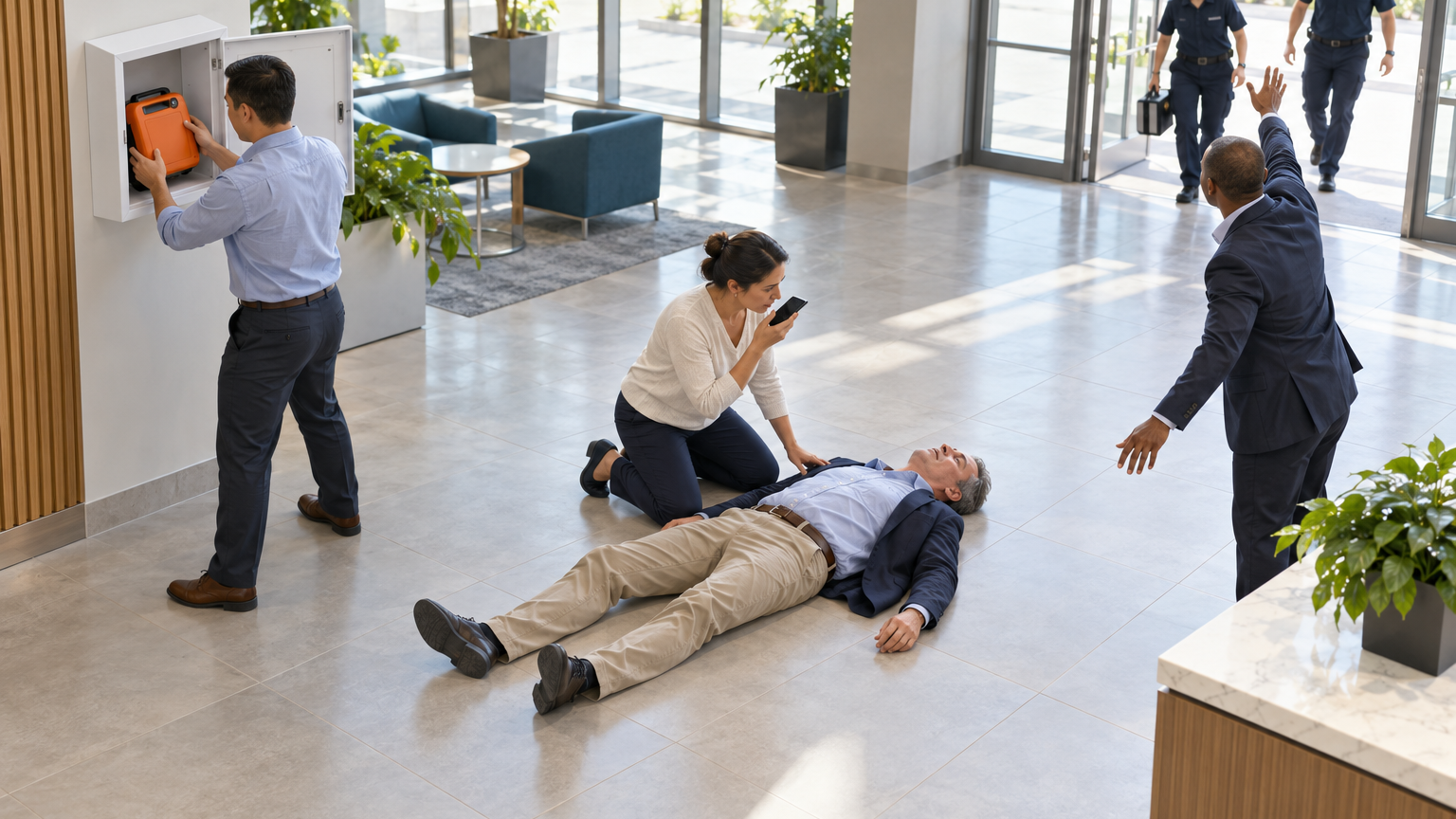
Caption: This illustration depicts bystander first aid. It does not represent an actual case and should not be used as a standard for technique or as clinical evidence.
First, Make Sure It Is Safe to Approach
Quickly check for traffic, electrical hazards, fire, smoke, or other ongoing dangers. If a hazard cannot be controlled, call for help from a safe location and tell the dispatcher what the danger is. Avoid becoming injured yourself. Assessing safety is the starting point for first aid. Resuscitation Council UK: First Aid Guidelines
Once it is safe to approach, gently tap both of the person's shoulders and ask loudly whether they can hear you. If there is no response, immediately call out for others to help and contact emergency services. Check the person's breathing while the call is being made. Do not delay calling to check repeatedly. Resuscitation Council UK: Adult Basic Life Support Guidelines
How to Describe Responsiveness and Breathing to the Emergency Dispatcher
Start with the exact location, including the building name, floor, entrance, or a nearby landmark. Then describe what you actually see. You might say, "Someone suddenly collapsed. They did not respond when I tapped their shoulders and called out to them, and I cannot see normal breathing." If the person is only gasping occasionally, say exactly that. Do not summarize it as "They're still breathing, so they should be fine."
Occasional gasps and slow, labored breathing can be signs of abnormal breathing. If the person is unresponsive and not breathing normally, treat the situation as suspected cardiac arrest. If you are unsure, ask the dispatcher to help you assess it. Resuscitation Council UK: Adult Basic Life Support Guidelines
During the call, prioritize the following information:
The exact location and the fastest way for emergency responders to reach it.
Whether the person responds when you call out or tap their shoulders.
Whether the person is breathing normally, not breathing, or only gasping occasionally.
Whether you witnessed the collapse and how many people are helping.
Whether chest compressions have started and whether an AED is at the scene.
If you do not know something, say so. Describing what you observe is more helpful than guessing whether it is a heart problem.
Use Speakerphone and Follow the Dispatcher's Instructions
Put your phone on speaker and place it where you can clearly hear the instructions. Tell the dispatcher whether you have received training, and follow the instructions as you listen. For an adult who is unresponsive and not breathing normally, bystanders who do not know how to give rescue breaths can provide continuous chest compressions as directed. Resuscitation Council UK: Adult Basic Life Support Guidelines
The basic requirements for adult chest compressions are to place the heel of one hand on the lower half of the breastbone in the center of the chest, place the other hand on top, and keep your arms straight. Push at a rate of 100 to 120 compressions per minute to a depth of about 5 to 6 centimeters. Let the chest fully recoil after each compression and minimize interruptions. People who are trained and able to give rescue breaths can use cycles of 30 compressions and 2 rescue breaths. These adult parameters should not be applied directly to infants and young children. American Heart Association: What Is CPR?
If the person is unresponsive but is clearly breathing normally on an ongoing basis, continue following the dispatcher's instructions and monitoring breathing. Do not perform chest compressions simply because the person collapsed. If there is no concern about traumatic injury, you may be instructed to place the person on their side in the recovery position. Someone who is gasping abnormally should not be placed in the recovery position in a way that delays CPR. If you suspect an injury, tell the dispatcher and follow their instructions about positioning. Resuscitation Council UK: First Aid Guidelines
How to Assign Calling, Equipment Retrieval, and Responder Guidance Tasks
Assign a specific person to each task and ask them to acknowledge it. For example: "Please call emergency services and put the phone on speaker," "Please get an AED," or "Please go to the entrance and guide the emergency responders here." Avoid having everyone leave at once to look for equipment.
If enough people are available, you can divide the tasks this way:
One person continuously performs chest compressions.
One person stays on the emergency call and relays instructions.
One person finds and brings back an AED.
Another person clears the access route and guides emergency responders inside.
If someone else can take over compressions, switch about every two minutes. Speak up sooner if you become tired, and keep the transition as brief as possible. If you are alone and can already call for help on your cell phone, do not leave the person and stop compressions for an extended period to search for an AED that is not within reach. Resuscitation Council UK: Quality Standards for CPR and AED Training in the Community
How to Follow an AED's Instructions
As soon as an AED arrives, turn it on and follow its voice prompts. The device analyzes the heart rhythm and determines whether a shock is needed. Bystanders do not need to identify the rhythm themselves. Even without training, you can follow the device's instructions. American Heart Association: Emergency Treatment of Cardiac Arrest
Attach the pads to the bare chest as shown in the diagrams on the pads. If the chest is wet, quickly dry it first so the pads adhere securely. During rhythm analysis and shock delivery, clearly tell everyone to stand clear and make sure no one is touching the person. At other times, continue providing emergency care as directed by the device. Resuscitation Council UK: Basic Life Support FAQs
If two people are helping, one should continue compressions as much as possible while the other prepares the device and attaches the pads, until the AED instructs you to pause. After a shock, or after the device says "No shock advised," immediately resume compressions as prompted. "No shock advised" alone is not a reason to stop CPR. Resuscitation Council UK: Quality Standards for CPR and AED Training in the Community
What Timeline and Details to Share When Emergency Responders Arrive
When emergency responders arrive, first clear a path to the person. Whoever is performing compressions should continue until a professional clearly takes over or instructs them to stop. If the person shows clear signs of responsiveness or starts breathing normally, report this immediately and reassess as directed. Do not mistake occasional gasps for recovery. Resuscitation Council UK: First Aid Guidelines
During the handoff, briefly explain what you personally observed and what actions have been taken:
When you saw the person collapse or when you found them.
Whether they were initially responsive and what their breathing was like.
Approximately when help was called and compressions began.
When the AED was used, whether it delivered any shocks, and the number of shocks, if known.
Whether the person became responsive, resumed normal breathing, or showed other changes along the way.
If you are uncertain about a time, say "approximately" or "I don't know." If you did not witness the collapse, explain when you found the person. Do not report the time you found them as the time they collapsed. Do not interrupt ongoing emergency care to recall exact times.
Reading Instructions Cannot Replace Hands-On First Aid Training
Understanding written instructions does not mean you can consistently achieve the correct compression position, depth, and recoil. Formal CPR and AED courses can help turn knowledge into action through manikin practice, equipment demonstrations, and feedback. Practice should also include calling for help and working with other bystanders. Resuscitation Council UK: Quality Standards for CPR and AED Training in the Community
The guidance in this article for responding to an adult's sudden collapse has limits. Infants, young children, and situations such as drowning require different or additional resuscitation measures, and the importance of ventilation must not be overlooked. In these situations, immediately explain what happened to the dispatcher and follow the appropriate instructions. Resuscitation Council UK: First Aid Guidelines
Prompt calls for help, CPR, and AED use can improve the chance of receiving lifesaving care, but individual outcomes depend on many factors and cannot be guaranteed. American Heart Association: About Cardiac Arrest
Find Nearby AEDs and Sign Up for Formal Training Today
Start preparing in places where you regularly spend time. Ask staff at your workplace, community facilities, or other venues about the exact location of the AED, how to get to it, and when it is accessible. Also confirm the local emergency phone number. Knowing that equipment is available is not enough; you should know how to retrieve it in an emergency.
When choosing a course, check whether it includes hands-on manikin practice, practice with an AED trainer, and feedback on technique. People who regularly care for children or participate in water activities should choose training that covers those situations. Core community training topics include recognizing emergencies, calling for help, performing CPR, and using an AED. Resuscitation Council UK: Quality Standards for CPR and AED Training in the Community
Frequently Asked Health Questions
1. How can I request verification through International Heart Care Center if the name or test date on a cardiovascular test report is incorrect?
First, contact the hospital or testing department that issued the report. Clearly identify the incorrect information and have your patient visit number, test documentation, and original report ready. Ask the hospital to verify whom the report belongs to and check the test records, then follow its official correction process. Do not alter the report yourself for medical use. If you have already submitted the report to another doctor, explain that the information is being verified and provide the corrected report when it is available.
2. How can people with cardiomyopathy at International Heart Care Center keep track of day-to-day changes in their health?
Keep a dated record of changes in activity tolerance, shortness of breath, chest discomfort, palpitations, dizziness, fainting, sleep disruption, and any measurements your doctor has asked you to monitor. Contact your medical team promptly if symptoms become noticeably worse than usual. If you develop severe difficulty breathing, persistent chest pain, fainting, or altered consciousness, seek emergency help immediately.
3. How should people with rheumatic heart disease at International Heart Care Center arrange a consultation if they notice a new decline in activity tolerance?
Record when the change began, which daily activities you can complete, and whether you also have shortness of breath, chest discomfort, palpitations, or swelling. Contact your regular follow-up doctor or a cardiology clinic promptly for an assessment. If you experience significant difficulty breathing, fainting, or rapidly worsening symptoms, seek emergency help immediately.