Heart Failure: Plan Fluids Around Your Care Instructions
Review date: 2026-09-15 · Credential: 110*********650
Abstract
Heart Failure: Plan Fluids Around Your Care Instructions
Heart Failure: Plan Fluids Around Your Care Instructions
After being told to "limit fluids every day," the real challenge is often not remembering a number, but figuring out: Does the water taken with medications count? How do you record milk at breakfast? If you had soup at lunch, how can you arrange the rest of the afternoon? A practical checklist needs to bring together the total amount confirmed by your doctor, the items to count, and daily scenarios, rather than simply drinking a few fewer glasses of water.
This article is for general health education. It does not provide a personal fluid limit, nor does it replace diagnosis, prescription, or individualized treatment arrangements.
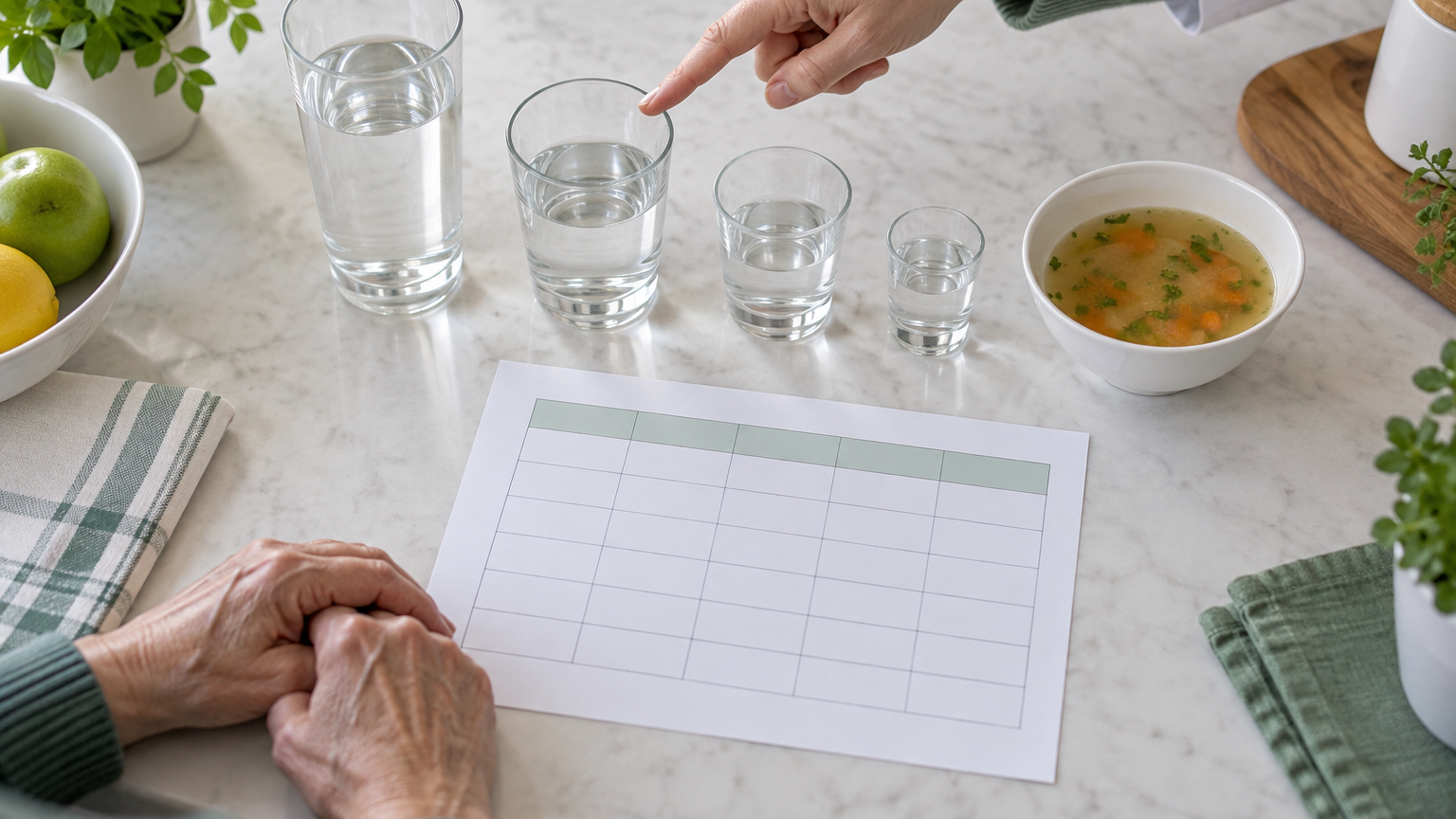
Caption: Illustration of fluid intake arrangement, used to help understand recording and distribution methods. It does not represent personal medical orders or clinical evidence.
First Confirm Whether There Is a Fluid Restriction Order and Its Applicable Stage
Heart failure patients cannot decide how much to drink each day based solely on the disease name. The American Heart Association's patient education materials suggest that heart failure patients should confirm with their healthcare team whether fluid restriction is needed and how much is appropriate to consume daily. Fluid restriction is not a one-size-fits-all arrangement. American Heart Association patient education materials
If you have already been asked to restrict fluids, first check your discharge records or current medical orders. A verbal reminder to "drink less water" is not enough to support accurate execution. You can ask the team to write down the following clearly:
What is the total daily amount, and is the unit in milliliters.
Is this number an upper limit, or a target range to follow.
What time does the day start, and is it recorded over a fixed consecutive 24-hour period.
Does the order apply during hospitalization, immediately after discharge, or in the current home follow-up phase.
When to review, and what situations require contacting the team in advance.
If the requirements during hospitalization differ from those after discharge, do not choose the more lenient or stricter one on your own. Ask the team to confirm the current effective version, and have the patient and caregivers use the same record.
Ask the Team Which Drinks and Foods Need to Be Counted
"Fluid restriction" cannot be simply understood as limiting only plain water. The UK National Health Service's relevant patient education materials remind that fluid restriction may also involve liquids in soups, stews, and foods like ice cream; in actual practice, the complete counting range needs to be confirmed. UK National Health Service relevant patient education materials
Rather than creating your own set of rules for water content in foods, list the items you commonly eat and drink for the team, and have the doctor, nurse, or dietitian confirm how to record them:
Plain water, tea, coffee, milk, juice, and water taken with medications.
Soup, porridge, noodle soup, and liquid in stews.
Ice cubes, ice cream, jelly, and other easily overlooked items.
Nutritional supplement drinks, liquid medications, and other items that need special measurement.
For fruits, yogurt, and other water-containing foods, also ask whether they need to be counted and what estimation method to use. Do not count all the water in foods on your own, nor delete meals or necessary nutritional supplements just to simplify recording.
The checklist should clearly state "what to count" and "how to measure," not just write "all liquids." This way, when a different family member prepares meals, there is less chance of different interpretations.
Use Common Cups and Bowls to Understand the Volumes in Medical Orders
"One cup" or "one bowl" is not a fixed volume. When implementing medical orders, first use a graduated measuring cup to measure the containers you commonly use at home, then mark the level you actually pour to. The measuring cup is for calibration; you do not need to re-measure every time you drink.
For example, a certain cup measured has a common capacity of 200 milliliters. Drinking from it twice is 400 milliliters. This is only an example of volume calculation, not a recommended intake, and does not indicate that other cups have the same capacity.
When measuring, note these details that can cause errors:
Distinguish between the full capacity of the container and the capacity you actually use.
Reconfirm the markings after changing cups, soup bowls, or thermoses.
Record the actual amount drunk; if there is leftover, deduct it according to a pre-agreed method.
For packaged drinks, refer to the label volume, and record how much you drank, not just "drank one bottle."
Patients and caregivers can consistently record in milliliters. This avoids repeatedly converting between cups, bowls, and bottles, and reduces duplicate bookkeeping.
Allocate the Daily Plan to Medication, Meals, and Outings
The daily plan should start from the total amount confirmed by the team, not from an online drinking schedule. There is no fixed ratio that must be copied; the key is to include in advance the fluids you already know will be used throughout the day.
First list medication times and the water needed for each dose. Do not skip doses, miss doses, or change the way you take medications just to save fluid allowance. Then list drinks with meals and foods that need to be counted, then arrange other times.
You can organize the day in the following order:
Mark the times for medications, breakfast, lunch, dinner, and outings.
Write down the items and volumes expected for each scenario.
Check whether the expected total matches the current medical order.
After each intake, record the actual amount and update the day's cumulative intake.
When the planned arrangement differs from actual circumstances, record the reason, and ask the team to help adjust if necessary.
When going out, bringing a water bottle with a known capacity is usually easier to record than buying drinks of different sizes on the spot. If eating out and unable to accurately judge soup volume, ask the team in advance for an acceptable estimation method.
The record sheet does not need to be complicated; it only needs time, item, actual intake, and cumulative total for the day. It is recommended that one person be responsible for the summary, and other caregivers record on the same sheet to avoid double-counting the same intake.
The remaining allowance does not mean it must all be drunk as a task, nor should it be a reason to deliberately drink less. First confirm whether the number in the medical order represents an upper limit or a target range.
What to Ask When Thirsty, Weather Changes, or Eating Difficulties Occur
When thirst is unbearable, the weather is hot, activity increases, or eating is difficult, the original plan may become hard to follow. At this time, describe the specific changes to the team, rather than increasing or tightening fluid restriction on your own.
When contacting them, provide the day's actual intake, the time thirst appeared, eating status, and whether fever, vomiting, or diarrhea occurred. You can also ask:
Is the current fluid restriction still applicable, and does it need early review.
Can oral care, rinsing and spitting, or other methods relieve discomfort.
If using ice cubes, how to count the melted volume.
How to coordinate diet and fluid arrangements when unable to complete meals or nutritional supplements.
Which symptoms require contacting the team the same day, and which situations require going to the emergency department directly.
Do not treat "thirst" simply as a reason to drink more, nor understand obvious discomfort as something to endure. If sudden severe shortness of breath, persistent chest pain, fainting, or altered consciousness occurs, contact local emergency services immediately; do not wait to finish organizing fluid records. The UK National Health Service provides emergency care warnings for sudden or severe related symptoms. UK National Health Service heart failure patient information
Verification Boundary: Do Not Apply Others' Fluid Limits, Do Not Adjust Diuretics on Your Own
This checklist addresses how to record and execute confirmed medical orders. It cannot judge whether you need fluid restriction, whether the restriction is adequate, or whether treatment should be changed. General patient education materials cannot replace individual assessment.
Daily amounts from family, other patients, or online articles should not become your own standard. Do not increase diuretics on your own because you drank too much one day; do not stop, reduce, or change medication times because of thirst, urine output changes, or inconvenience going out. The American Heart Association's heart failure medication education materials emphasize that medication should follow the healthcare team's guidance and not be changed on one's own. American Heart Association heart failure medication education materials
If you exceed the medical order on a given day, record the exceeded items, volumes, and physical sensations, and handle it according to the team's contact instructions. Do not take "compensatory" measures such as drastically drinking less the next day or taking extra medication on your own.
If the team also requires recording weight, blood pressure, or symptoms, bring this information to follow-up visits for review. The fluid record is a communication tool, not a basis for self-judging the condition and adjusting medications.
Final Action: Ask the Care Team to Confirm an Executable Fluid Checklist
At the next communication, bring the measured capacities of your common cups and bowls, and a day's actual diet record. Ask the team to confirm the following checklist, rather than just asking "How many more glasses of water can I drink?"
Current daily fluid upper limit or target range: To be filled in by the team.
Daily recording start and end times: To be confirmed by the team.
Drinks, foods to be counted, and estimation methods: To be confirmed by the team.
Expected volumes for medications and meals: Fill in based on actual life and check.
Handling methods for outings, thirst, or eating difficulties: To be confirmed by the team.
Situations requiring early contact, contact information, and next review date: To be filled in by the team.
After confirmation, place the effective version where both patient and caregivers can easily see it. When medical orders change, note the update date to avoid continuing to use old numbers.
The key to fluid restriction is not to drink as little as possible, but to clearly record intakes that are easily missed, promptly feedback difficulties in life, and make medical orders truly executable within the range confirmed by the professional team.