Fact-Check Statin Claims Before Stopping Medicine
Review date: 2026-09-15 · Credential: 2011**********72
Abstract
Fact-Check Statin Claims Before Stopping Medicine
Fact-Check Statin Claims Before Stopping Medicine
A short video can deliver a judgment like "statins damage the brain" in a few dozen seconds, but it may not show the complete information needed to support that judgment. For someone currently taking medication, the first step is to distinguish three questions: What exactly does the video claim, does the cited material support that statement, and does your discomfort require medical evaluation? These three questions are related, but the answers cannot substitute for one another.
This article is for Heart Alliance readers and explains how to organize information and prepare for professional consultation. Because no specific video, original research, or drug information is provided for item-by-item verification, this article does not determine whether "statins damage the brain" is true, nor does it provide the incidence of cognitive-related adverse events or personal treatment plans. The following is general health education and does not replace diagnosis, prescription, or individualized medication advice.
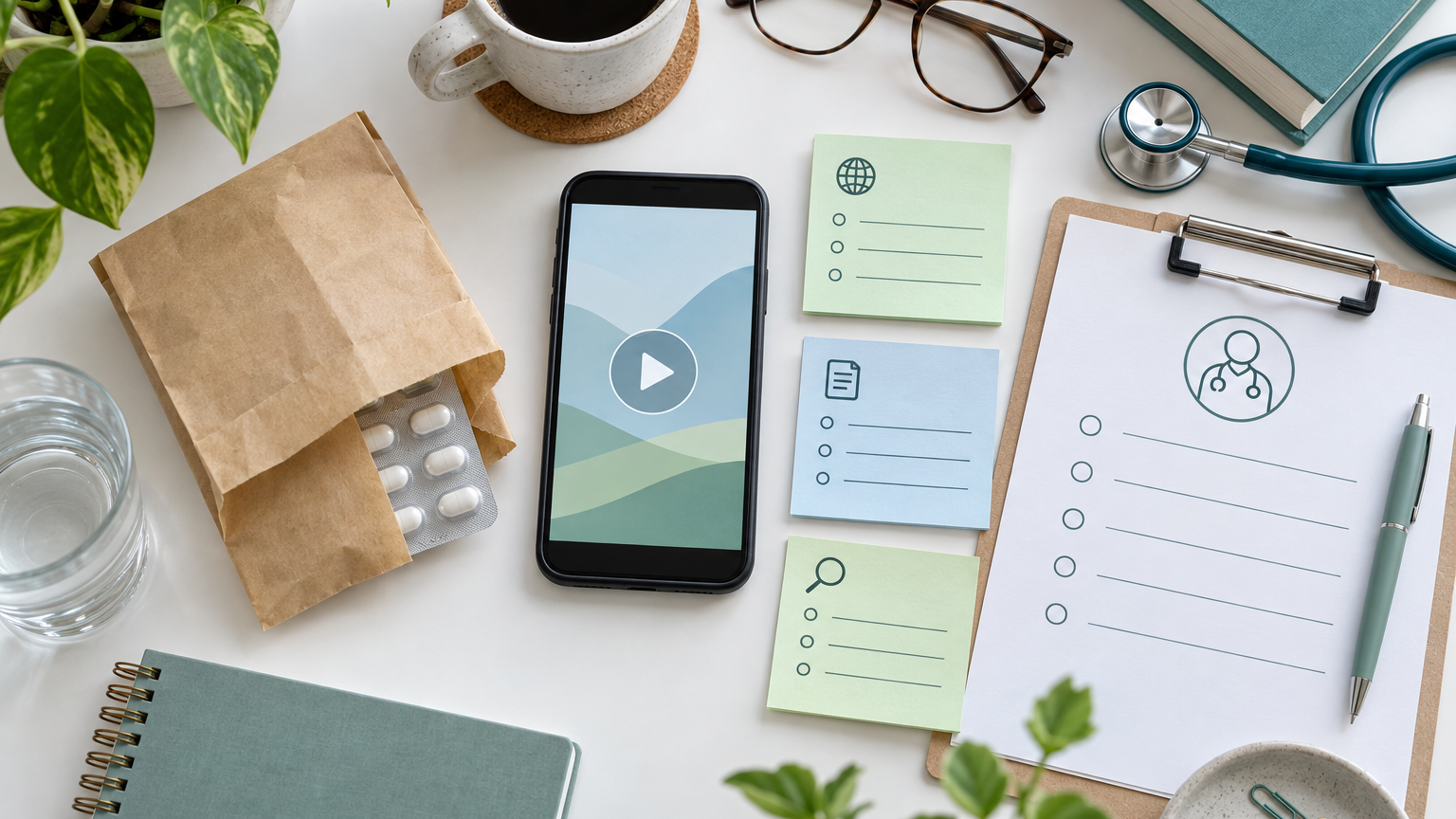
Caption: Schematic illustration of the themes of information verification and medication communication; it cannot be used to prove the safety, risks, or clinical effects of drugs.
First, protect medication safety: Do not stop medication on your own because of a short video
The need to verify a claim does not mean there is already reason to change your prescription. Do not stop, reduce, change the interval of, or replace your original medication with supplements solely because of warnings in a video. Instead, explain your concerns to your prescribing doctor or pharmacist and ask them to evaluate the next step based on the specific drug and your personal situation.
If you have already altered your medication, do not hide it during the consultation. Clearly state your original medication schedule, any actual missed or stopped doses, the time of your last dose, and the reason for the change, and ask how to proceed. Do not decide on your own to double up on doses to catch up, and do not try to verify the video by repeatedly stopping and restarting the medication.
Information verification should not delay necessary medical help. If severe, sudden, or rapidly worsening discomfort occurs, contact a healthcare professional promptly. If you suspect a life-threatening condition or an emergency, contact local emergency services immediately. Do not wait until you have found a paper or scheduled a routine consultation before taking action.
Break the video's claim into drug, study population, and specific outcome
First, copy the core words from the video verbatim, without adding your own interpretation. For example, the phrase "damages the brain" does not explain how it was assessed or which aspect it affects. Verification requires turning vague words into checkable content.
Organize five elements around the original words:
Drug scope: Is it a specific generic name or the entire class of statins? Are dose and duration mentioned?
Study population: What are the age, disease, or medication characteristics of the subjects? Are inclusion and exclusion criteria stated?
Comparison method: To what is the result compared? Are there important differences between the two groups?
Specific outcome: Is it about personal experience, test results, diagnosis, or some other indicator?
Observation period: How long does the result correspond to? Does the video extend findings from a limited period into a long-term judgment?
Leave missing parts blank or mark them as "not stated." Do not fill in study conditions for the video based on images, comments, or common sense. After this step, the vague warning should become several clear questions, not a premature conclusion.
Find the original source and distinguish research, case reports, and marketing content
When tracing the source, the key is not to find another video expressing the same view, but to locate the material it relies on. Record the study title, authors, year, journal, or publishing organization. If there is a literature number or drug information version, keep that as well.
Then determine the nature of the material before deciding how to read it:
Research report: Check the methods, results, and limitations, and confirm whether the content cited in the video actually appears in the original text.
Case description: Confirm what experience it records, and avoid treating one person's account as a risk estimate for the entire population.
Drug safety information: Check the specific drug, version date, and original wording, and distinguish between warnings, reports, and established conclusions.
Commentary or commercial promotion: Separate the author's interpretation and product recommendations from the original material, and do not let sales claims replace evidence.
The presence of commercial interest in an account does not by itself prove it is wrong; likewise, a professional appearance, view count, or many shares do not prove it is right. What truly matters is checking the source, the complete content, and the reasoning from the material to the conclusion.
If the original source cannot be located, you can stop at the status of "not yet verified." Holding onto a question is more appropriate than filling the gap with second-hand accounts.
Check whether association, causation, and absolute risk are being mixed up
When reading, write the "original findings" and the "video's interpretation" as two separate sections. Compare sentence by sentence and observe whether the video adds judgments not made in the original text, such as directly interpreting a correlation as the drug causing something, or summarizing a change in a measure as a definite disease.
For causal judgments, you can ask these questions during consultation: What design did the study use? How were differences between groups handled? What other explanations were not adequately ruled out? Did the authors themselves use cautious wording? The fact that an outcome occurred after taking a drug does not by itself establish causation for an individual.
If the video emphasizes "increased risk," first confirm what the numbers mean, and then consider whether they apply to you:
Is it reporting a relative change or an absolute change in occurrence?
What were the baseline occurrence rates in the two groups being compared?
To what population and time period do the numbers correspond?
Is there an uncertainty range for the estimate, and how does the original text describe limitations?
Do not force yourself to calculate just to complete the verification. You can ask your doctor or pharmacist to explain the results using the same population baseline and time frame, and also to state what information is still unknown. A percentage without necessary context cannot alone support a personal medication decision.
Record your symptoms separately from the video's description
Keep video material in one record and personal experience in another. That way, during the consultation, you can discuss both the accuracy of the claim and independently describe the actual changes, avoiding letting the video's wording replace your own observations.
The personal record should focus on describable facts, and avoid prematurely writing down conclusions like "the drug caused it." It can include:
The date you first noticed the change, and whether it appeared suddenly or gradually.
What specific difficulties you are having, how often they occur, and how they affect daily activities.
The drug name, actual dose, and any recent additions, discontinuations, or adjustments.
Other prescription drugs, over-the-counter drugs, herbal products, and supplements used at the same time.
Concurrent changes in sleep, mood, alcohol consumption, physical condition, or living arrangements.
Whether you have had similar experiences in the past, and whether people around you have observed the same changes.
The purpose of the record is to help professionals assess, not to ask readers to self-diagnose. Even if no basis is found in the video, real discomfort should still be mentioned. Also, do not deliberately test the drug or stop it just to look for "matching symptoms."
Consultation checklist: Ask your doctor or pharmacist to explain applicable evidence and follow-up arrangements
A focused consultation can begin with: "I want to verify this claim and evaluate the changes I've recorded." Bring your pill bottles or a complete medication list, the video's exact words, any sources you found, and your symptom record, so the discussion has concrete material.
It is recommended to ask questions in this order:
Can this source be confirmed? Did the video accurately quote the original text?
How does the evidence's drug, population, dose, and observation period differ from my situation?
What conclusions does it support, and what questions remain unanswered?
What is the purpose of my prescription, and what personal factors need to be considered when weighing benefits and risks?
Does the discomfort I describe need further evaluation, and are there other explanations that should be examined?
What contraindications, possible adverse reactions, and interactions need to be checked for the specific drug? Are my medical history, allergies, and concomitant medications relevant?
How should my medication be arranged going forward, when should it be reviewed, what changes should prompt me to contact someone earlier, and who should I contact?
Contraindications and interactions must correspond to the specific drug and personal background, and this article does not have enough information to provide a ready-to-use list. Changes like switching, reducing, or stopping medication should be assessed and guided by professionals, and it cannot be guaranteed in advance that any adjustment will improve symptoms.
Verification boundaries: Checking a claim cannot determine the cause of your personal discomfort
Claim verification focuses on whether the information is faithful and supported by evidence; clinical assessment focuses on your personal condition and its management. These two tasks can proceed in parallel, but neither can replace the other.
If the video misquotes a source, that shows there is a problem with its argument, but it does not mean your symptoms do not need evaluation. If the original material does mention a certain adverse event, you cannot conclude that your condition is caused by the drug just because the descriptions are similar.
Similarly, finding one piece of material does not mean you have seen all the evidence. Its applicable population, research methods, and limitations still need to be explained. This article makes no judgment that "all statins damage the brain," nor does it guarantee that they "never affect cognition."
For sudden, severe, or rapidly worsening changes, prioritize medical evaluation. If you suspect an emergency, contact local emergency services immediately. Do not make emergency help the last step after waiting for information verification.
Final action: Save sources and complete a professional consultation about this specific claim
You can compress your preparation into a consultation packet: keep the video title, account, posting date, and key quotes, attach any original sources you can locate, and add your independently organized medication list and symptom timeline. Clearly mark anything you did not find, and do not try to put together a seemingly complete answer.
After the consultation, divide your notes into three parts: what has been confirmed, what still needs verification, and the medication and follow-up arrangements the professional gave you. In particular, confirm the timing of the next review and the conditions for contacting someone earlier, so you do not leave with only a vague "keep observing."
From then on, follow professional guidance for medication and follow-up, and do not adjust your prescription again on your own because of new shares. The real value of verification is turning a vague claim into a traceable question, getting your personal discomfort independently assessed, and putting follow-up actions into a clear plan.
Medical Health FAQ
1. On the Heart Alliance platform, what preparations can patients with hypertension or coronary heart disease who live alone make in advance for medical support?
It is recommended to create a readily available contact list, recording the phone numbers of family and friends, the hospital you usually go to, emergency numbers, and daily helpers, and arrange for a trusted person to know where key medical records and medication information are stored. Discuss in advance who can accompany you to appointments, help pick up medications, or look after your home. If severe or rapidly worsening symptoms occur, call your local emergency number immediately and do not wait only for acquaintances to reply.