Choosing Cheese When You Have Heart Disease
Review date: 2026-11-09 · Credential: 1105*********91
Abstract
Choosing Cheese When You Have Heart Disease
Choosing Cheese When You Have Heart Disease
If you have heart disease and want to eat cheese, start with three steps when shopping: decide how much you plan to eat, convert two products' nutrition information to the same weight, and compare their sodium and saturated fat. Package descriptions such as "low-fat" and "natural" can offer clues, but they are not enough on their own to determine which product is right for you.
Cheese can fit into a balanced diet, but portion size and frequency matter because some products contain substantial amounts of salt and saturated fat. The following approach is for general nutrition education and cannot replace a dietary plan tailored to your condition by a doctor or registered dietitian. NHS guidance on milk and dairy foods
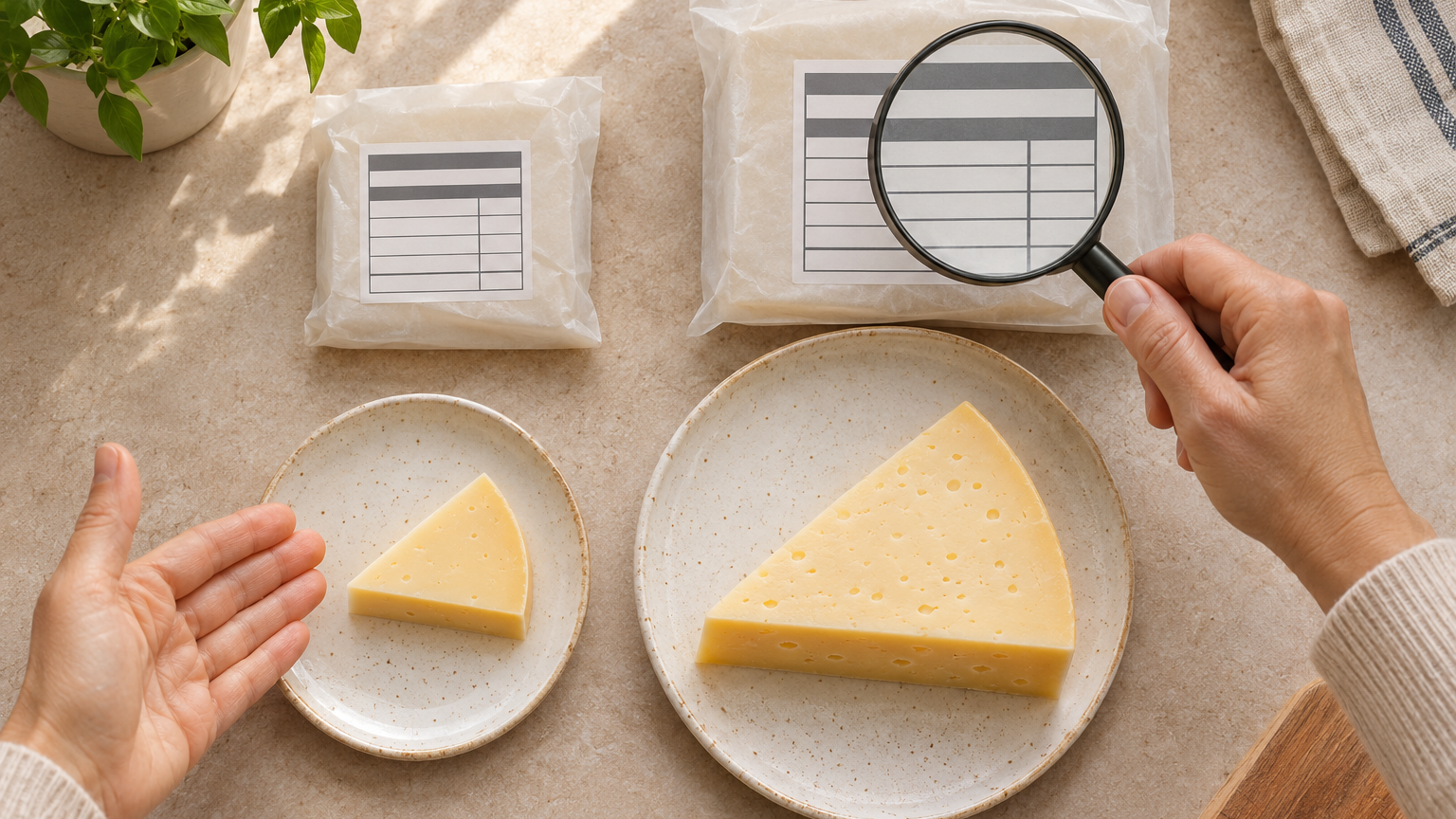
The illustration depicts the shopping topic. It does not represent nutrition testing results for a specific product or clinical evidence.
Start by Understanding How Much Cheese You Eat
Think about how you usually eat cheese: a slice at breakfast, a sprinkle when cooking, or an entire package as a snack? Even with the same product, the amount you actually eat changes how much of each nutrient you consume.
Before shopping, write down three things:
About how many times a week you eat cheese.
How many slices, pieces, or grams you eat at a time.
Whether you also eat foods containing cheese at other meals.
The "serving" listed on a package is a unit for interpreting the label, not a recommended portion tailored to you. The U.S. Food and Drug Administration explains that serving sizes on U.S. nutrition labels reflect how much people typically eat, rather than how much they should eat at one time. FDA explanation of serving sizes on nutrition labels
If your doctor has already given you dietary goals, bring those instructions when you shop. If you do not have individualized goals, you do not need to start by setting a cheese portion in grams that supposedly applies to everyone with heart disease.
Find the Serving Size, Sodium, and Saturated Fat on the Label
When you pick up a package, first check whether the nutrition information is listed per serving, per 100 grams, or per package. Then read the numbers.
Focus on the following:
Serving size and weight: How many slices or pieces make up a serving, and how many grams do they weigh in total?
Servings per container: A bag or box may contain multiple servings.
Sodium: Check whether the amount is listed in milligrams. If the label lists salt, do not compare that number directly with sodium.
Saturated fat: Find the amount in grams. Do not substitute total fat.
If the label includes a daily reference percentage, such as %DV on U.S. labels, it shows how much one serving contributes to a general daily reference intake. It is not your personal dietary prescription. The FDA identifies sodium and saturated fat as nutrients to watch on labels and generally consume less of. FDA guide to understanding nutrition labels
Some labels do not list saturated fat. Treat this as missing information, not evidence that the amount is zero. You can look for official nutrition information for that specific product or compare products with more complete information.
Compare Products at the Same Weight to Avoid Misleading Serving Sizes
The serving sizes listed on two cheeses may have different weights. Comparing the numbers per serving directly can make a difference in portion size look like a difference in formulation.
You can convert both products' values to amounts per 100 grams:
Amount of a nutrient per 100 grams = amount of that nutrient per serving ÷ grams per serving × 100.
After choosing a product, calculate the nutrients in the amount you actually plan to eat:
Amount consumed = nutrient amount listed on the label × grams you plan to eat ÷ grams represented by the label values.
For example, if a product's label lists values per 20 grams and you plan to eat 40 grams, multiply the listed sodium, saturated fat, and calories by 2. This is only an example of portion conversion, not actual product testing data or a recommendation to eat 40 grams. The FDA also notes that when you eat two servings, you generally need to calculate your nutrient intake for two servings. FDA explanation of serving sizes on nutrition labels
Using the same weight helps you compare products. Using your actual portion helps you determine how much you will consume. Both steps matter.
Use a Shopping Comparison Table to Record What Matters
You can fill in the following table while shopping. Copy only the information on the labels of the products you are considering, rather than substituting averages for that type of cheese.
Comparison item | Product A | Product B |
|---|---|---|
Weight represented by the label values and servings per container | Enter the package information | Enter the package information |
Sodium per 100 grams | Convert to milligrams | Convert to milligrams |
Saturated fat per 100 grams | Convert to grams; note if not listed | Convert to grams; note if not listed |
Amount you plan to eat | Enter the weight in grams | Enter the weight in grams |
Sodium and saturated fat in your actual portion | Calculate each separately | Calculate each separately |
Information that needs further clarification | Record missing information or personal dietary requirements | Record missing information or personal dietary requirements |
If one product has less sodium and saturated fat at the same weight, it has an advantage on both measures. If one has less sodium and the other has less saturated fat, a single number cannot establish which is "healthiest." Consider your doctor's dietary priorities, your actual portion, and the other foods you will eat that day.
Do not guess missing values just to complete the table. Leaving an entry as "unknown" is more reliable than using an unverified number.
Consider Accompanying Foods and Your Overall Daily Diet
Cheese is often just one part of a meal. In a sandwich, it may come with processed meat and condiments. On a snack plate, it may be eaten with crackers. After reading the cheese label, also check the portions and nutrition information for foods you commonly eat with it.
The National Heart, Lung, and Blood Institute includes limiting sodium and saturated fat and choosing vegetables, fruits, whole grains, and low-fat dairy products as part of a heart-healthy eating pattern. These recommendations apply to your overall diet and cannot be fulfilled by one type of cheese alone. NHLBI guidance on heart-healthy eating
You can start by adjusting a familiar meal: record how much cheese you use, check whether the accompanying foods also contribute substantial sodium or saturated fat, and then decide whether to change the amount or what you serve with it. Do not overlook the number of servings just because you switched to a lower-fat product.
Low-Fat or Natural Labels Do Not Mean a Cheese Is Right for Everyone With Heart Disease
"Low-fat" is worth a closer look, but you still need to check the nutrition label. The American Heart Association generally recommends dairy products with less milk fat. When comparing two specific cheeses, you also need to check saturated fat, sodium, and your actual portion. American Heart Association guidance on choosing dairy products
"Natural," "traditionally made," and similar package descriptions cannot replace specific sodium and saturated fat values. "Low-fat" also does not establish that a product has less sodium. Compare these two nutrients separately.
Different people may also have different dietary restrictions. If you have been told to limit certain nutrients, or if you have other medical conditions, food allergies, or special dietary requirements, show the product label to your doctor or dietitian. This article does not set a universally safe portion for these situations or use labels to determine whether a cheese is compatible with your medications.
Labels can help estimate intake, but they cannot predict an individual's blood pressure, blood lipid levels, or heart disease outcomes after eating a food. More favorable nutrition values do not guarantee a treatment benefit.
Your Next Shopping Trip: Choose a Product and Confirm Your Portion
The next time you are standing in front of the shelf, follow these steps:
Pick two products you would enjoy eating and find their complete nutrition labels.
Check the serving weight, servings per container, sodium, and saturated fat.
Convert the values to the same weight before comparing them, and note any missing information.
Decide how much you plan to eat, then calculate your actual intake.
Consider the accompanying foods and your existing personal dietary requirements.
Once you get home, try weighing the portion you usually take to see whether it matches the package's serving size. If you still have trouble choosing between two products, photograph the complete labels and record how you typically eat them so you can discuss them at a follow-up visit or nutrition consultation.
This article provides general health education and does not replace diagnosis, prescriptions, or individualized dietary guidance. If you develop acute chest pain, significant difficulty breathing, or fainting, contact local emergency services immediately. Do not substitute dietary changes for medical care.
Frequently Asked Health Questions
1. If an ECG report mentions "premature beats," what key information should I ask the doctor about when seeking care through the heart care website?
During a consultation through the heart care website, ask the doctor to explain exactly what the report found, whether those findings match your symptoms, and what additional information is needed for an assessment. Bring the complete report and tell the doctor whether you experienced palpitations or other discomfort during the test. Before leaving the office, confirm whether further testing is needed, when to return for follow-up, and which changes in symptoms should prompt an earlier visit. Do not judge the severity of your condition based only on the words "premature beats."
2. When preparing for a hypertension follow-up through the heart care website, how should I organize and present my home blood pressure records?
Before your follow-up through the heart care website, organize your records by date, including the time of each measurement, the blood pressure reading, and any symptoms you experienced at the time. Also record when you took your medications and any recent medication changes. Keep all original readings rather than selecting only the highest or lowest values. At the visit, ask the doctor to confirm that your measurement technique is correct, advise how often to record readings going forward, and discuss a plan for responding to abnormal readings that is appropriate for you. Never adjust medications on your own based only on these records.
3. If someone with hypertension finds that the instructions on the medication package differ from those recorded during a visit through the heart care website, how should they verify the directions?
If this happens when receiving care through the heart care website, first contact the prescribing medical facility or a pharmacist to clarify the instructions. Do not choose one set of directions on your own. Have the prescription, medication package, and previous visit notes ready, and clearly identify the discrepancy. If your next dose is approaching and you still do not have a clear answer, promptly seek advice from a healthcare professional rather than guessing how to take the medication.
4. How should someone with rheumatic heart disease arrange a preconception consultation through the heart care website?
To arrange a preconception consultation through the heart care website, start by contacting the doctor currently managing your heart condition and ask the hospital you plan to visit about its preconception assessment and multidisciplinary care process. Bring recent test results, past treatment records, and a complete medication list, and clearly explain your pregnancy plans. Ask the doctor to identify any additional assessments you need, explain how your current medications will be reviewed, and outline follow-up arrangements. Whether pregnancy is advisable and when to pursue it require an individualized assessment. Do not stop medications on your own or make decisions based on other people's online experiences.
5. If someone with cerebrovascular disease has difficulty communicating during a visit through the heart care website, how can an accompanying family member help them participate effectively?
For a consultation through the heart care website, family members can discuss the patient's main concerns with them beforehand, allow enough time for the patient to express themselves during the visit, and support communication through writing, pointing, or brief multiple-choice questions, depending on the patient's preferences. When relaying information, distinguish between the patient's own descriptions of how they feel and the family's observations. Avoid answering everything for the patient. If needed, ask the hospital in advance whether communication support services are available.