Build a Workplace AED Response Plan
Review date: 2026-09-26 · Credential: 110*********564
Abstract
Build a Workplace AED Response Plan
International Heart Care Center Office Has AED but No One Knows Where It Is: How to Create an Emergency Response Plan for Collapse Ahead of Time
Having an automated external defibrillator (AED) in the office does not automatically mean you have reliable emergency response capability. If employees don't know where the device is, access routes are blocked by doors, or no one on site is clear about who is responsible for calling emergency services, there can still be confusion and delays when someone actually collapses.
The focus of creating a plan is not to have ordinary employees determine the cause of illness, but to clearly define actionable steps in advance: after noticing an abnormal situation, quickly confirm the safety of the scene and the person's responsiveness, contact the local emergency system, retrieve the AED, and provide assistance within your ability according to the emergency dispatcher's instructions, the device's voice prompts, and formal training requirements.
First, Clarify the Goal: Reduce Delays in Locating Equipment and Calling for Help in Advance
The emergency plan should be designed around the actual office environment, not just a line in a document saying "use the AED in case of an accident." The team needs to address at least the following issues in advance:
Who is responsible for checking whether the person is responsive and immediately calling for help from people nearby.
Who contacts the local emergency system to accurately provide the address, floor, and situation on site.
Who retrieves the AED and other available first aid supplies.
Who goes to the entrance, elevator, or access control point to meet the rescue personnel.
Who is responsible for dispersing onlookers and preserving necessary rescue space.
Who checks the equipment status, replenishes supplies, and documents issues for improvement afterward.
The plan should not require untrained employees to make medical diagnoses independently. If a person suddenly collapses, is unresponsive, or shows abnormal breathing, it should be treated as a possible emergency. Contact the local emergency system as soon as possible and follow the dispatcher's real-time instructions. If there is fire, electrical hazards, traffic, or other dangers on site, first prevent the rescuer from being exposed to further danger.
Conduct a Site Walkthrough of AED, Phones, Entrances, and Routes Accessible to Rescue Personnel
An effective walkthrough should start from the actual locations where employees are most active, not just from looking at floor plans. You can have different employees go from conference rooms, office areas, break rooms, and near restrooms to the AED and observe whether they can find the device without prompting.
During the walkthrough, check:
Whether the AED is placed in a fixed, visible, and easily accessible location.
Whether the device is blocked by furniture, boxes, or locked cabinets.
Whether it can be accessed normally at night, on weekends, or when the office area is closed.
Whether access cards are needed on different floors, and whether elevators may be restricted.
Whether office phones need a prefix to dial an outside line or emergency number.
Whether there are alternative communication methods in areas with weak cell phone signals.
What access gates, elevators, and turning points rescue personnel need to pass from the building entrance to the incident location.
Whether the front desk, property management, security, and other units on the same floor know how to cooperate in granting access.
The walkthrough results should be compiled into a concise location map and route description. The map can indicate the AED, office phones, main entrances, elevators, stairs, and assembly or meeting points, but should not include employees' illnesses, medications, or other health privacy information.
Verify Equipment Signage, Access Hours, and Maintenance Responsibility
There should be clear and consistent signage near the AED, and it should not be obstructed by decorations. Only placing a small label on the equipment cabinet is usually not enough to help people unfamiliar with the environment locate it quickly. Directional signs can be placed at hallway corners, floor entrances, or public areas as appropriate, while complying with building management and local regulations.
Equipment management should be assigned to a specific role, not relying on "everyone will keep an eye on it." The maintenance responsible person should regularly check according to the manufacturer's instructions and applicable local requirements:
Whether the status indicator shows the device is ready.
Whether the battery, electrode pads, and other accessories are within their expiration dates.
Whether the packaging is intact and the device is not damp, overheated, or impacted.
Whether the cabinet, alarm device, and signage are in good condition.
Whether the device has been checked, replenished, or restored according to established procedures after use.
The frequency of inspections, documentation methods, and replacement standards should be based on the device manual, local regulatory requirements, and the organization's own policies. If abnormalities are found, contact the equipment supplier, maintenance personnel, or other qualified professionals. Do not attempt to repair it yourself based on experience.
Role Assignments: Check Responsiveness, Call Emergency Services, Retrieve AED, and Guide Rescue
Emergency assignments should be role-based, with backup personnel for each role. This way, even if the designated employee is on leave, traveling, or not on site, the plan can still operate.
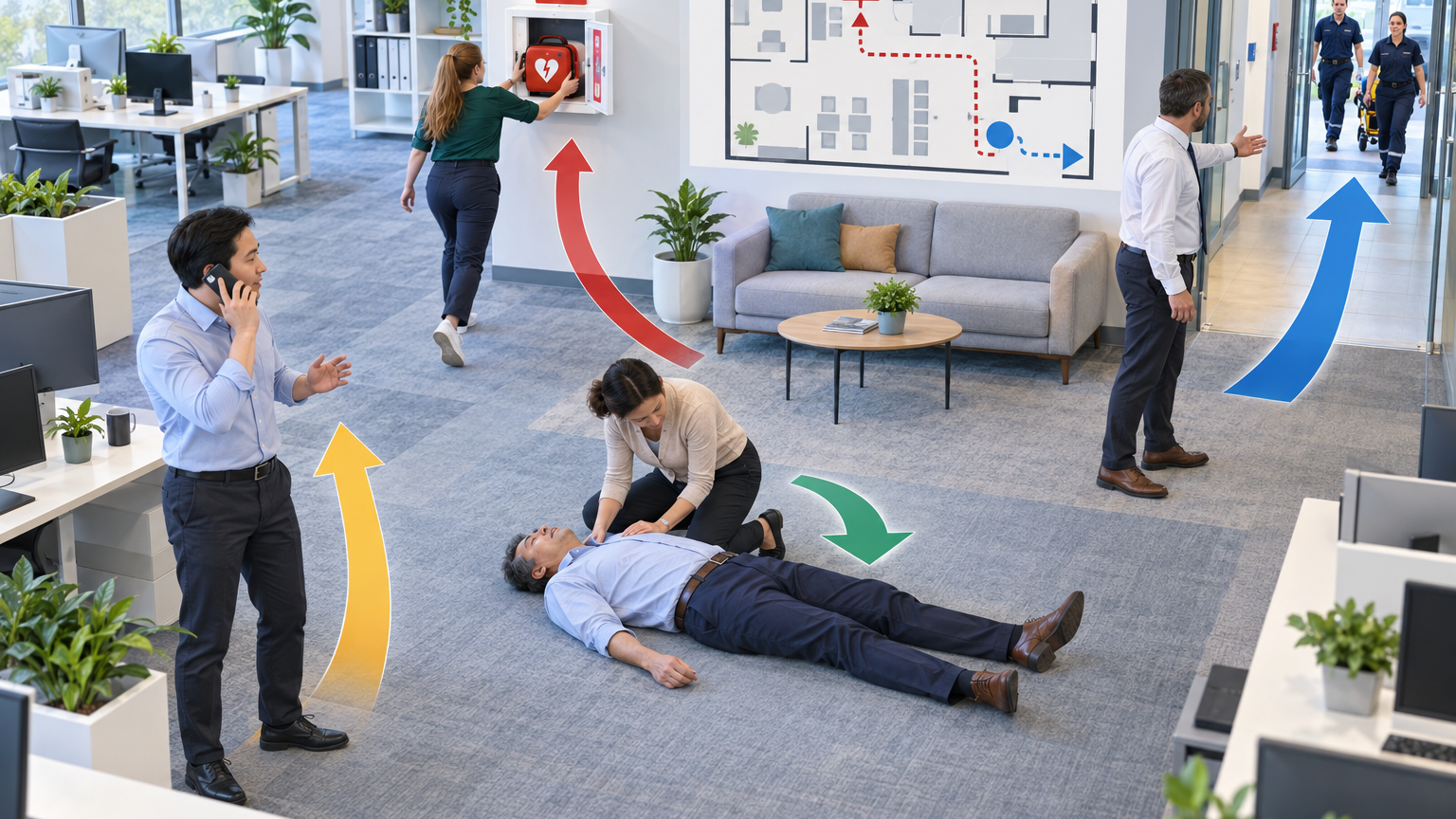
The first responder should first assess whether the surrounding environment is safe, call out to the collapsed person, and observe for any response. If the person is unresponsive or the situation is concerning, immediately shout for help, specifically instruct one person to contact the local emergency system, and instruct another person to retrieve the AED. Don't just shout "someone call", because vague instructions may lead everyone to think someone else has already acted.
The person calling for emergency services should state the organization's name, full address, floor, room or area, entrance location, and observable conditions on site, and keep the phone line open. If the dispatcher asks questions or gives first aid instructions, answer truthfully and act according to the guidance.
The person retrieving the AED should follow the pre-confirmed route to get the device and bring it to the scene as soon as possible. Once the device arrives, turn it on and follow the voice or visual prompts. Whether and how to perform CPR, use the AED, or take other first aid measures should be determined based on the training of the people on site, dispatcher guidance, device prompts, and local regulations. No one should delay contacting professional emergency personnel by waiting for an internal manager to arrive.
The guide should go to the designated entrance, ensure that access gates, elevators, or pathways are usable, and bring the rescue personnel directly to the scene. The on-site coordinator should also control the crowd, keep passageways clear, and prevent unrelated people from filming or spreading information about the collapsed person.
Use Short Scenario Drills to Identify Access, Floor, and Language Barriers
Drills can use tabletop simulations or scenario walkthroughs that do not involve touching a person or actual discharge. If operating training devices or practicing CPR, it should be organized by qualified trainers using appropriate training equipment.
A short drill can be set up as: someone suddenly collapses in a conference room, the first responder calls out without response, and then needs to contact the emergency system, retrieve the AED, and guide rescue personnel inside. Observers should focus on recording actual obstacles in the process, such as:
Employees can only say the company's short name and cannot provide the full address.
The AED is on another floor, but the access card does not have permission for that floor.
The front desk is unmanned during lunch or after hours.
The elevator requires security personnel to operate.
There is a language communication difficulty between on-site employees and the emergency dispatcher.
The office background noise is too loud to hear the device prompts clearly.
Most employees do not know who the backup coordinator is.
After the drill, immediately compile the issues and assign a responsible person and completion date for each. Improvement measures may include updating address cards, adjusting access permissions, setting up bilingual location instructions, arranging backup personnel, or reposting route maps. The purpose of the drill is to test the process, not to evaluate or publicly criticize individual employees.
How to Post Necessary Information Without Exposing Employee Health Privacy
Publicly posted information should serve the purposes of location, contact, and action, and should not include any employee's health status. Recommended content to post includes:
The floor and specific location of the AED.
The local emergency number and how to dial it from an office phone.
The full address of the workplace and entrance instructions.
Information on access gates, elevators, and meeting points.
Emergency roles or position titles and their backup arrangements.
The equipment maintenance role and internal reporting method.
The date of the last check and the next review date.
Do not post in public areas any employee's diagnosis, medications, allergy history, past emergency experience, or other identifiable health information. Even if an employee has a cardiovascular disease, it does not mean their condition should be made public or the emergency plan should be designed solely around that employee. If the organization legally maintains voluntarily provided emergency health information for individual employees, it should use controlled access and appropriate privacy protection measures, and comply with local laws and company policies.
Verify Boundaries: The Plan Cannot Replace Formal First Aid Training or Dispatcher Guidance
Location maps, assignment cards, and drills can reduce organizational confusion, but cannot replace formal CPR and AED training, nor can they guarantee any individual's medical outcome. The AED will provide operation prompts based on its own analysis and program. Ordinary employees should not infer whether a shock is needed on their own, nor bypass the device prompts.
The office should also note the following boundaries:
Do not rule out a serious condition based on suspicion of fainting, fatigue, or other reasons.
Do not prioritize looking up personal medical history, contacting family, or waiting for management approval over calling emergency services.
Do not allow unauthorized personnel to repair, modify, or test the AED.
Do not use real electrode pads on a person or attempt discharge during drills.
Do not treat this article as a substitute for local laws, occupational safety regulations, or device manuals.
If a person collapses and is unresponsive, breathing abnormally, or shows other potentially life-threatening signs, contact the local emergency system promptly. On-site personnel should prioritize the dispatcher's guidance and accurately report the observed situation and measures taken after professional rescue personnel arrive.
Final Actions: Complete a Walkthrough, Post the Location Map, and Set a Review Date
International Heart Care Center can start with a site walkthrough covering primary office hours. After the walkthrough, compile the AED location, emergency number, full address, meeting route, and role assignments into a one-page concise information sheet and place it in a location that is easily visible and updatable for employees.
Then, clearly identify the equipment maintenance person, process owner, and backup personnel, resolve issues found during the walkthrough regarding access, communication, floors, and language, and arrange a short drill. Finally, write down the next review date and recheck promptly after office relocation, layout changes, equipment replacement, personnel changes, or access rule changes.
The value of this plan is not in how long the document is, but in whether every employee can answer three basic questions: Where is the AED, who should be contacted first when someone collapses, and how can rescue personnel reach the scene fastest.
Medical Health FAQ
1. What steps should be taken to resolve issues related to costs or insurance authorization when scheduling overseas cardiovascular medical services through the Heart Alliance?
It is recommended to verify with the medical institution and the insurance company the specific service items, estimated costs, coverage, whether pre-authorization is required, the individual's out-of-pocket portion, and the required diagnostic certificates or referral materials, and keep written communication records. Since actual examinations or treatments may change costs, understand the confirmation process for cost updates in advance. Do not ignore symptom changes while waiting for insurance approval; if an emergency occurs, call the local emergency number immediately or go to the nearest hospital.
2. What information should coronary heart disease patients tell medical staff before undergoing dental or other surgeries at the Heart Alliance?
They should proactively inform the diagnosis of coronary heart disease, previous examinations or surgeries, current symptoms, all medications being taken, and allergy history, and provide the contact information of the primary cardiovascular doctor. Especially important is not to stop any cardiovascular medication on one's own; medication adjustments or additional tests should be decided by relevant specialists based on the type of surgery and individual risk.