Build a Bilingual Heart Care Summary
Review date: 2026-09-23 · Credential: 110*********650
Abstract
Build a Bilingual Heart Care Summary
Build a Bilingual Heart Care Summary
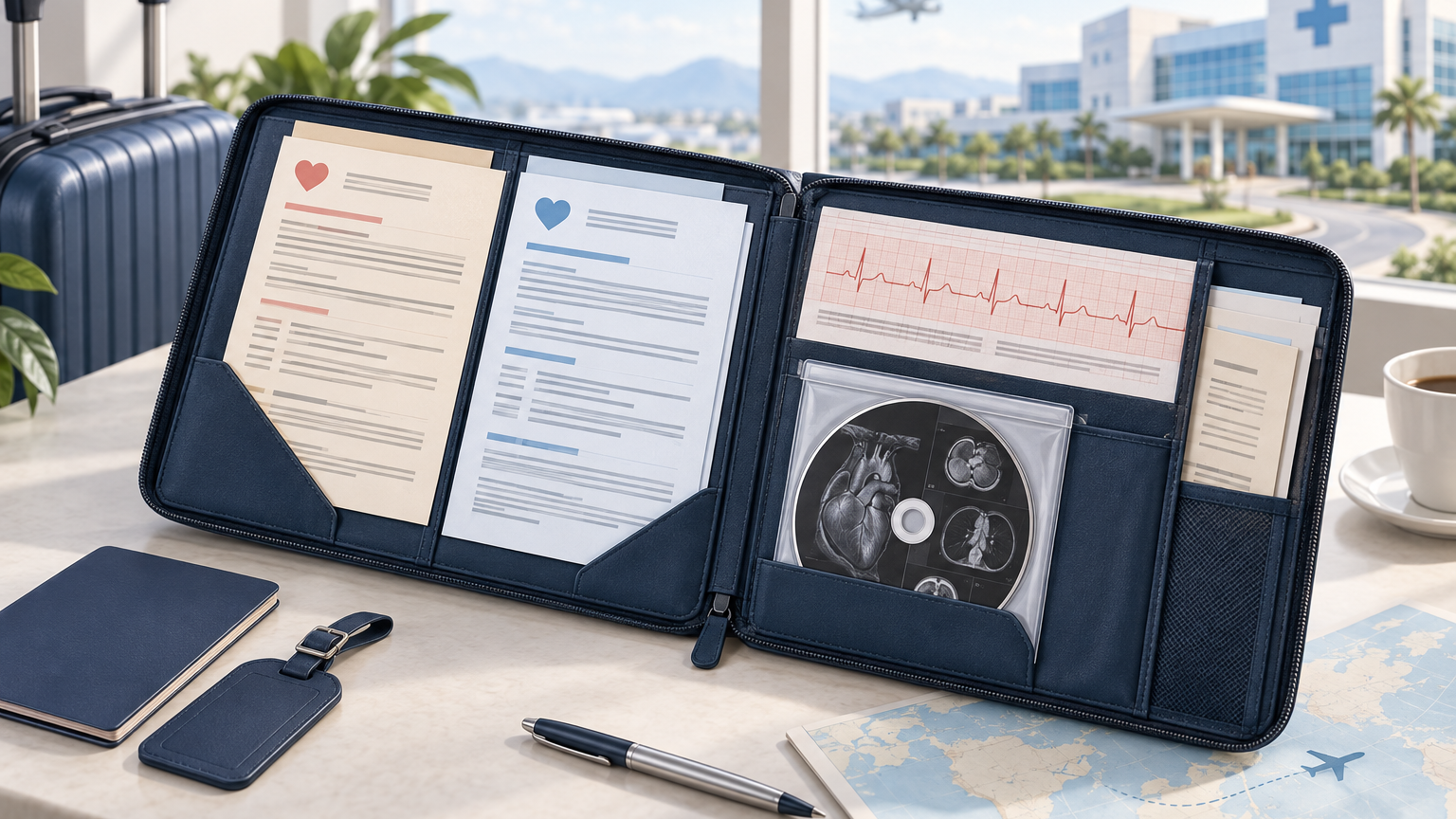
Before an international cardiac visit, preparing a bilingual medical summary is not about interpreting your condition yourself, but about helping the receiving team quickly locate original records, identify confirmed information, and understand the questions you hope to address during this visit. The summary should be faithful, concise, and traceable; any translation should correspond to the original text and cannot replace original reports, professional translation, or the judgment of the medical team.
First Identify the Main Question to Address During This International Visit
Start by stating the primary purpose of the visit in one or two sentences, such as reviewing a previous diagnosis, evaluating a surgery or interventional procedure, checking an implanted device, explaining persistent symptoms, or discussing a follow-up management plan. Listing too many goals at once may cause key issues to be buried under a large amount of information.
The main question can be recorded as follows:
What is the issue you want to resolve?
When did the symptoms or condition begin, and have there been recent changes?
What evaluations or treatments have already been performed?
What is the original medical team most concerned about now?
What specific questions do you want the receiving team to answer?
Patients can describe their own experience, but should not write speculation as a diagnosis. For example, you can write "patient describes chest discomfort after activity," but not "confirmed myocardial ischemia" without formal diagnostic evidence. If you currently have persistent chest pain, significant shortness of breath, fainting, altered consciousness, or other rapidly worsening symptoms, you should not wait for the international visit or the completion of medical record organization; contact local emergency services or healthcare professionals promptly.
Organize Source Documents by Category: Diagnosis, Procedures, Devices, Tests, Allergies, and Current Medications
It is recommended to first create a catalog of documents by category, then write the summary. For each item, indicate the document name, date, issuing institution, and original language, avoiding keeping only paraphrased content.
Diagnosis: Keep the original names from diagnostic certificates, discharge records, and specialist clinic notes, and note the date and institution of diagnosis.
Surgery and interventional procedures: Record the procedure name, date, hospital, and available surgical records, catheterization lab records, and discharge documents.
Implanted devices: Record device type, brand, model, implantation date, and implanting institution, and carry the device identification card and the most recent follow-up or programming records.
Tests: Organize electrocardiograms, echocardiograms, imaging studies, exercise or stress tests, and related reports.
Allergies and adverse reactions: Separately record known allergens, reactions experienced, and the source of information. When unsure whether it is an allergy or another adverse reaction, note "uncertain" truthfully.
Current medications: Record the original generic and brand names, dosage form, dose per administration, frequency, route, start date, and known purpose. Do not identify medications solely by pill color or shape.
If medications have been stopped recently, also record the name, date, and known reason for discontinuation. Do not stop, add, or adjust medications on your own in preparation for the visit; relevant changes should be evaluated by healthcare professionals familiar with your condition.
Which Names Should Keep the Original Text with a Translation, Not Just a Self-Translation
Names that are critical for identity verification, medication identification, or medical interpretation should be presented in the format "original first, translation after." At minimum, include:
Hospital, department, and physician names.
Official diagnosis names.
Names of surgeries, interventional procedures, and anesthesia methods.
Drug generic names, brand names, dosage forms, and strengths.
Brand, model, and serial information of implanted devices.
Test names, report conclusions, and key measurement fields.
Allergen names and descriptions of reactions.
When the translation is uncertain, do not guess. Keep the original text and mark "pending professional confirmation." When abbreviations appear for the first time, write out the original full term; the same abbreviation may have different meanings in different institutions, so you should not expand it on your own based solely on the letter combination.
How to Standardize Dates, Institutions, and Report Sources in a Timeline
Date formats in international documents may vary. It is recommended to consistently use the full numeric format of "year, month, day," for example, "September 23, 2026," and state the date format at the beginning of the summary. When the time is clear, you can also record local time and time zone; if the exact date cannot be confirmed, write "approximately in [month]" or "date unknown," and do not fabricate precise dates.
Each entry in the timeline should include:
Date of event.
Institution where the event occurred or document was issued.
Event type, such as visit, hospitalization, test, surgery, device follow-up, or medication adjustment.
Confirmed facts.
Corresponding original document file name or number.
The report issuance date may differ from the examination date; record both separately. The timing of symptoms recalled by the patient should also be distinguished from dates in medical documents to avoid writing recalled content as report conclusions.
Bilingual Summary Template: Write Confirmed Facts, Patient Description, and Unanswered Questions Separately
The summary can use a two-column table, but you don't need to put all original reports sentence by sentence into the table. The core principle is to make the original text and translation correspond item by item and clearly indicate the nature of the information.
Column | Suggested Format |
|---|---|
Purpose of this visit | Original wording and corresponding translation; list one main question and necessary secondary questions |
Confirmed facts | Fill only content verifiable from formal medical records, reports, prescriptions, or device documents, and cite the source |
Patient description | Record symptoms, timing, triggers, and changes, clearly labeled as patient or family statement |
Current medications and allergies | Keep original text of drug names, strengths, and reactions, with translation and most recent verification date |
Important timeline | List institutions, events, and corresponding original documents by date |
Pending questions | List discrepancies between reports, terminology doubts, missing documents, and questions you want the physician to explain |
After completion, check that original text and translation are aligned item by item. Do not fill in unknown information to make the summary look complete, and do not change expressions like "possible," "considered," or "cannot be excluded" into a confirmed diagnosis.
How to Keep Original Files and Corresponding Reports for Imaging, ECG, and Lab Tests
For imaging, ECG, and laboratory data, try to keep both original files and official reports. Providing only screenshots, images forwarded via chat apps, or reformatted values may lose identity information, dates, units, reference ranges, or image details.
When organizing, you can do the following:
Save imaging files and imaging reports separately, and create filenames that correspond to each other.
Keep the complete original ECG tracing and the report issued by the machine or physician, not just the automated conclusion.
For lab results, keep item names, values, units, reference ranges, collection time, and issuing institution.
Scans should cover the entire page with consistent text direction, avoiding cutting off headers, stamps, page numbers, or report conclusions.
Keep original files unchanged; save translations as separate files and use clear numbers to correlate with originals.
Testing methods, units, and reference ranges may differ between institutions; do not convert values on your own and delete the original numbers. If conversion is necessary, keep the original value, original unit, converted value, conversion method, and who performed it for professional review.
Before Departure, Confirm Accepted Formats, Languages, and Submission Channels with the Receiving Institution
Different receiving institutions may have different requirements for file formats, translation qualifications, imaging media, and upload methods. Before departure, confirm directly with International Heart Care Center or the official channel coordinating the visit:
Whether Chinese originals are accepted, and whether translations into English or other languages are required.
Whether certified translation, sworn translation, or a specific format is required.
Which document and imaging formats are accepted, and the file size limit for individual files.
Whether imaging must be submitted through a designated platform, disc, or other media.
Whether advance upload is required, the deadline, and whether you still need to bring originals when you arrive.
Which verified secure channel the files should be sent to.
Do not infer acceptance requirements from unofficial hearsay. Before sending medical records, verify the recipient institution, contact person, and channel, and avoid sending files containing identity information to unconfirmed emails, chat accounts, or public links.
Verification Boundaries: Machine-Translated Summaries Cannot Replace Certified Translation or Medical Team Interpretation
Machine translation can assist in organization, but may mistranslate negations, dosages, abbreviations, anatomical sites, and medical expressions with uncertainty. Any automatically generated translation should be kept alongside the original text and verified by a person with appropriate language skills, familiarity with the condition, or meeting the receiving institution's requirements.
Items requiring item-by-item review include:
Drug names, dosages, frequencies, and routes.
Allergies and severe adverse reactions.
Procedure names, implanted device information, and dates.
Negations, comparisons, and uncertain expressions in reports.
Numerical values, decimal points, units, and reference ranges.
The bilingual summary is only a communication tool and cannot replace certified translation, complete medical records, or the receiving team's interpretation of original imaging, test results, and clinical situation. If you find inconsistencies between the original and translation, keep both and mark for verification; do not choose one version as the final conclusion on your own.
Final Actions: Have a Team Familiar with Your Condition Review the Summary and Keep Paper and Electronic Backups
Before departure, ask doctors, nurses, pharmacists, or medical records managers familiar with your condition to help review key content within their scope of responsibility, especially current medications, allergies, past procedures, implanted devices, and recent tests. Patients themselves should also confirm that name, date of birth, contact information, and emergency contact are accurate.
Recommended checklist:
Every important fact can be traced to a corresponding original document.
Original text, translation, and attachments use consistent numbering.
Current medication list is marked with the most recent verification date.
Uncertain, missing, or discrepant information is clearly marked.
Paper copies are in your carry-on materials, and electronic copies are stored in a securely accessible location.
Important files have appropriate access protection and are not stored on only one device.
This summary should be updated as new tests, medication changes, or hospitalizations occur. It can help the international medical team understand the document structure, but you should not use it for self-diagnosis or treatment changes. If your condition changes significantly before departure, first contact your local medical team to assess whether travel is appropriate and whether timely management is needed.
Medical Health FAQ
1. In the Heart Alliance, when a family member needs to pick up cardiovascular medications on behalf of a patient, what materials should the patient prepare in advance?
The person picking up the medication should have the patient's identity document and authorization documents as required, the latest prescription, medication details, allergy information, the name of the dispensing institution, and contact information for healthcare providers. After pickup, verify the patient's name, drug name, strength, directions, quantity, and expiration date; if it does not match the original treatment plan, confirm with the prescribing institution or pharmacist first, and do not switch medications, adjust doses, or stop taking them on your own. Actual pickup regulations should follow the requirements of local medical institutions and pharmacies.