After a Home Sleep Test: Plan the Next Step
Review date: 2026-09-21 · Credential: 1105*********91
Abstract
After a Home Sleep Test: Plan the Next Step
After a Home Sleep Test: Plan the Next Step
A home sleep test report's indices do not equal a complete diagnosis. The device, recording quality, actual sleep time, symptoms, and prior cardiac history can all influence how a physician interprets the results. The following content helps you organize materials and prepare for a follow-up visit; it does not replace professional diagnosis or individualized treatment advice.
First confirm whether you have raw data, a technical summary, or a formal report
Start by checking the file name, issuing organization, test date, and signature information. The material you have may be raw device records, automated analysis results, a technician-prepared summary, or a clinically reviewed formal report. Different materials serve different purposes.
You can first confirm with the testing organization:
Whether this document has been reviewed by a qualified professional.
Whether automatically identified respiratory events have been manually verified.
Whether the report includes notes on recording quality, missing signals, or technical limitations.
Whether a formal conclusion has not yet been issued.
Who is responsible for interpreting the results in the context of symptoms and medical history.
If you only have device interface screenshots or a few numbers, do not use them to determine on your own whether you have a sleep disorder.
What respiratory events, oxygen levels, and recording duration each describe in the report
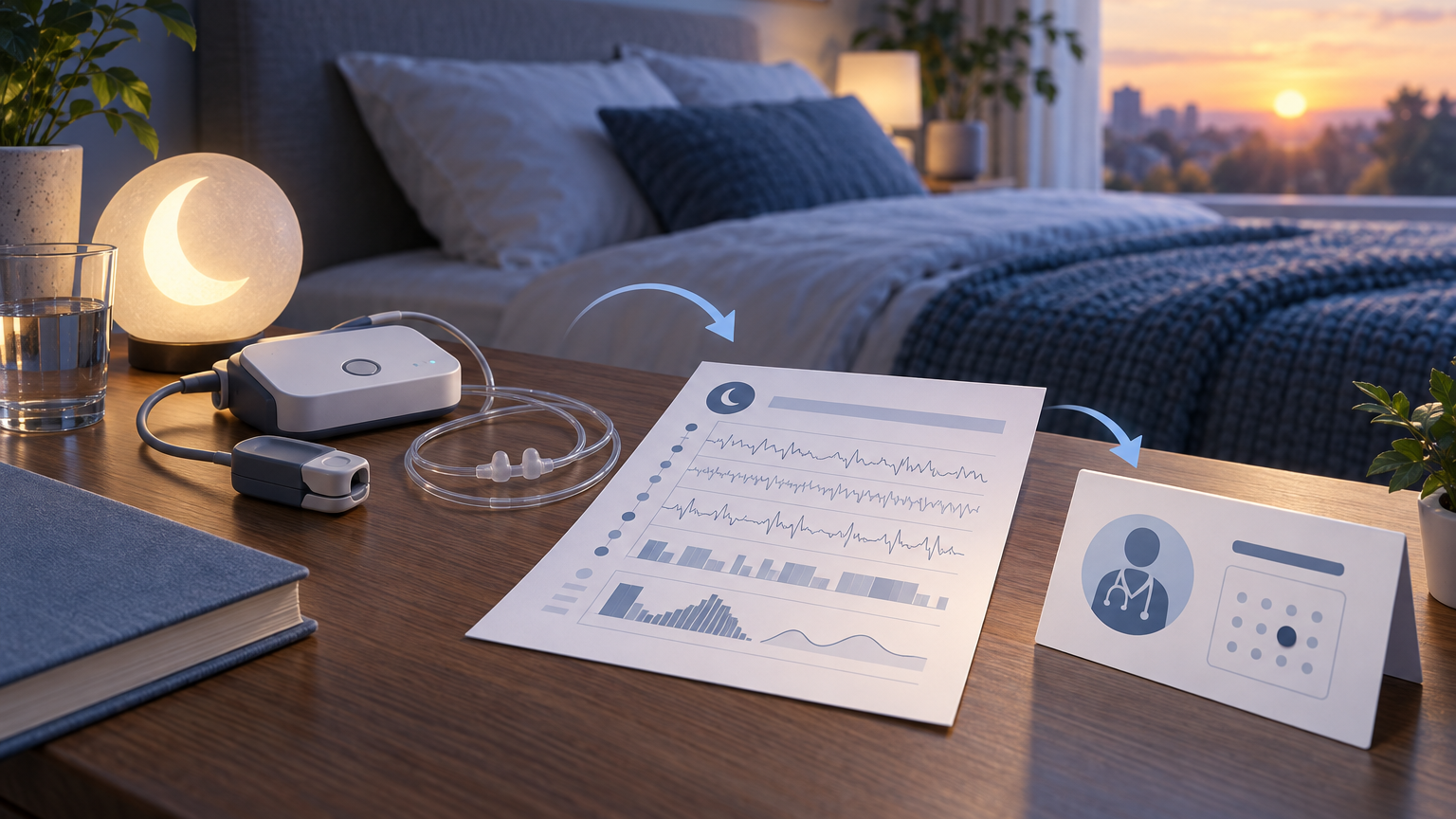
Home sleep test reports typically describe the night from different angles. Specific names, calculation methods, and reference ranges may vary by device and organization; always rely on the formal report's definitions and the physician's interpretation.
Respiratory event indices reflect breathing changes identified by the device during valid recording periods, but a single summary number cannot fully show when events occurred, their relationship to body position, duration, or signal reliability.
The oxygen section may show nighttime oxygen changes, lower readings, or cumulative time within specific ranges. Sensor movement, limb activity, peripheral circulation status, and other factors can affect readings, so obvious abnormalities need to be judged in conjunction with raw waveforms and recording quality.
Recording duration indicates the time the device obtained signals, but it is not necessarily equal to actual sleep time. If awake time is long, some results calculated based on recording duration may differ from what actually happened during sleep.
When reading, do not just circle the highest or lowest numbers; also check:
Whether the valid recording covers a representative night.
Whether nasal airflow, respiratory effort, oxygen saturation, and pulse signals are complete.
Whether the report indicates insufficient data, artifacts, or periods that could not be analyzed.
Whether abnormalities are concentrated in a particular body position or time period.
Whether the report conclusions are consistent with your symptoms.
Why a single home sleep test may not answer all sleep questions
A home sleep test is information obtained on a specific night, with a specific device, and under specific recording conditions. Which questions it can answer depends on the purpose of the test, the signals recorded by the device, and data quality.
A single result may not fully explain insomnia, abnormal behaviors, limb movements, circadian rhythm changes, or other non-respiratory sleep problems. Even if the report shows no clear abnormalities, if symptoms persist, cardiovascular risk is a concern, or technical quality is suboptimal, a professional should still determine whether retesting, alternative assessments, or investigation of other causes is needed.
Conversely, an abnormal report does not mean that a single index alone can determine severity, cause, or the most appropriate treatment. Results need to be understood within the complete clinical context.
Organize snoring, daytime sleepiness, nighttime awakenings, and cardiac history together
Before the follow-up visit, use a brief timeline to record the two weeks before and after the test, including:
Whether snoring occurs frequently, and whether family members have observed breathing pauses or unusual gasping.
Whether you experience nighttime awakenings with a choking sensation, repeated awakenings, morning headaches, or dry mouth.
Whether you are sleepy during the day, have reduced concentration, or have dozed off while driving or operating equipment.
Your bedtime on the test night, estimated sleep duration, alcohol consumption, and medication use.
Whether you have hypertension, coronary artery disease, arrhythmias, heart failure, or other diagnosed conditions.
Whether you have recently experienced chest discomfort, palpitations, changes in exercise tolerance, shortness of breath, or fainting.
All current prescription medications, over-the-counter drugs, and supplements, and whether doses have been adjusted recently.
This record is not for self-diagnosis but to help professionals managing sleep issues and heart disease see the same complete picture.
Results discussion checklist: what to ask about conclusions, reliability, and next steps
When scheduling the report explanation, ask in order:
What question was this test originally intended to answer, and to what extent was it answered?
Are the report conclusions definitive, suggestive, or inconclusive?
Is the data quality sufficient, and which periods or signals are unreliable?
Could the difference between recording time and estimated sleep time affect interpretation?
Do respiratory events and oxygen changes need further evaluation in the context of cardiac history?
Could there be other causes for current symptoms that need investigation?
Is the next step observation, retesting, further testing, or discussing treatment?
If no immediate action is taken, under what circumstances should you return earlier?
Who is responsible for integrating sleep, cardiac, and medication information?
Ask the physician to clearly separate conclusions, uncertainties, and the next-step plan. If the explanation remains ambiguous, request that it be written in the medical record or follow-up summary.
If treatment or further testing is recommended, confirm goals, responsible parties, and review points
If a professional recommends further testing or treatment, first confirm its goal: which symptoms to improve, which identified risks to reduce, or which unresolved question to clarify. Also ask who will prescribe, who will guide use, who will monitor effectiveness, and whom to contact if problems arise.
Also clarify review points, such as when symptoms, device data, tolerance, or relevant test results will be assessed. Treatment effectiveness cannot be judged solely by subjective feeling or a single device reading; the responsible team should determine the specific review method.
If you are receiving care from cardiology, sleep medicine, or primary care simultaneously, ask one professional to coordinate to avoid duplicate tests, conflicting advice, or missed medication information.
Which severe nighttime breathing or waking symptoms require prompt help
If you experience severe or rapidly worsening breathing difficulty, persistent chest pain or pressure, fainting, altered consciousness, or obvious bluish discoloration of the lips and face, do not wait for a routine report explanation appointment; immediately contact local emergency services or seek urgent medical evaluation.
If daytime sleepiness affects driving or high-risk activities, stop those activities and promptly contact a medical professional to discuss safety arrangements. Repeated nighttime awakenings with choking, significantly worsening symptoms, or family observation of concerning breathing abnormalities also warrant timely contact with your physician, who can judge urgency.
Verification boundaries: do not self-diagnose, choose devices, or adjust cardiac medications based on a single index
Any single indicator in the report must be interpreted in the context of testing method, signal quality, symptoms, and medical history. Do not ignore persistent symptoms because a number appears normal, nor self-diagnose because a number is abnormal.
Without professional evaluation and standardized guidance, do not purchase, borrow, or adjust sleep-related breathing devices on your own, and do not stop, add, or change cardiac medications based on home sleep test results. Device settings, medication adjustments, and their interactions require evaluation by a professional who understands your complete condition.
Final action: create a one-page sleep results summary and schedule the explanation appointment
Condensing information to one page is often easier for discussion than bringing scattered screenshots. The summary can include:
Test date, device or organization name.
Report type and whether it has been formally reviewed.
Original report conclusions and data quality notes.
The three most bothersome symptoms and their duration.
Diagnosed cardiac conditions and other significant medical history.
Complete medication list and recent changes.
Three core questions you want the physician to answer.
Next appointment time, responsible person, and materials to bring.
After completing the summary, schedule the formal results explanation and bring the complete report, not just the conclusion page. Before the follow-up visit ends, confirm the next action, responsible person, completion deadline, and review time. The purpose is not to interpret a diagnosis yourself but to smoothly connect limited test information to subsequent professional evaluation.
Medical Health FAQ
1. At the Heart Alliance, when patients with hypertension or coronary artery disease face multiple test appointments, how should they decide which one to do first?
When going to the Heart Alliance, first ask the department that ordered the tests to clarify the purpose, urgency, preparation, estimated duration, and which physician will interpret the results for each test, then prioritize according to the follow-up visit schedule. If preparations for different tests seem contradictory, the relevant departments should coordinate; patients should not stop medications or adjust the process on their own. If unable to complete tests on time due to health conditions or mobility issues, contact the Heart Alliance as soon as possible to reschedule a reasonable test order.