Adding Whole Grains to Your Daily Meals
Review date: 2026-10-13 · Credential: 110*********650
Abstract
Adding Whole Grains to Your Daily Meals
Adding Whole Grains to Your Daily Meals
To make whole grains part of your daily meals, start with a meal you know well: identify the grain-based food you usually eat, choose a whole-grain ingredient with clear labeling and convenient preparation instructions, and try replacing part of your usual serving. The goal of your first attempt is to find something you enjoy eating and can easily prepare again. You do not need to change all your grain choices at once.
This guide provides general nutrition education, focusing on food selection and planning a trial meal. It does not assess your personal cardiovascular risk or provide treatment plans. If you already have specific dietary instructions from a healthcare professional, first confirm which changes are appropriate for you.
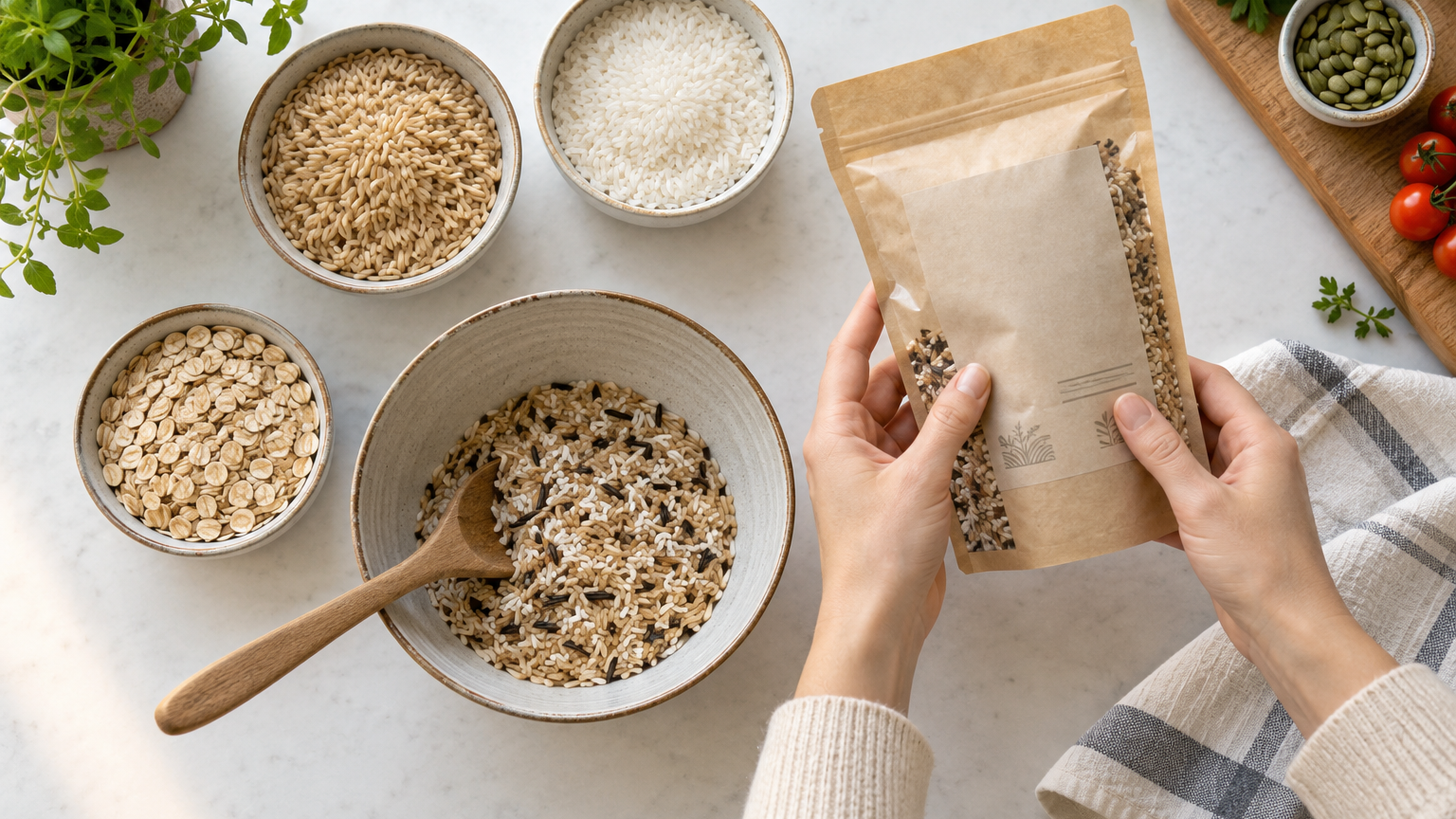
The image illustrates a meal combination. It does not represent clinical evidence or portions appropriate for an individual.
Start with the Grain-Based Food You Eat Most Often
Think about a meal you eat regularly and can easily plan. Is it rice at dinner, a bowl of noodles at lunch, or bread or oatmeal in the morning? Choose a meal where you can decide which ingredients to use and have time to try something new.
The more specific your starting point, the easier it is to act. For example, replace "eat more whole grains from now on" with "next time I cook rice, try replacing some of the white rice with a small amount of brown rice." This is simply a cooking experiment, not a recommendation that everyone use the same proportions.
For your first attempt, change just one part of the meal. When you change the grain, keep familiar side dishes and seasonings so you can more easily judge whether you like the new texture. Also, avoid adding an extra serving of whole grains on top of your usual grain portion. This trial focuses on replacement.
How Whole-Grain Names, Ingredient Labels, and Food Forms Relate
To understand whole grains, start with the grain kernel itself: whole grains retain the bran, germ, and endosperm. They may come as intact kernels, rolled flakes, or flour, so an intact kernel or a coarse texture is not the only way to identify them.
When shopping, consider the product name, ingredient list, and preparation method together. Brown rice can be an option for rice-based meals, products made with whole-wheat flour can be options for noodles or bread, and rolled oats can be a breakfast option. Check each product's packaging to confirm its actual ingredients and how it has been processed.
"Multigrain" means a product contains several types of grains, but the name alone does not tell you whether they are all whole grains. Dark bread, grains sprinkled on the surface, or wording such as "coarse grains" cannot substitute for ingredient information.
When you pick up a food product, check the following:
Whether the ingredient list clearly names ingredients such as whole-wheat flour, brown rice, or oats, rather than relying only on claims on the front of the package.
Whether the product states its whole-grain content. If it does not, do not estimate the percentage yourself.
Whether it contains ingredients you need to avoid and whether there are relevant allergen warnings.
Whether the preparation method works with your cookware, available time, and storage conditions.
Whole-grain content is one factor to consider when choosing grain-based foods. It cannot, by itself, tell you whether an entire product or meal is appropriate for you.
Choose a Manageable Swap for Rice, Noodles, Bread, or Breakfast
If you often eat rice, try replacing some white rice with a small amount of brown rice. Before buying, check the package instructions for soaking, water amounts, and cooking. Different products may require different methods, so you do not need to use your usual white-rice cooking routine. If the grains cook unevenly when combined, next time you can prepare each according to its own instructions and serve them together.
If you often eat noodles or bread, choose one whole-wheat noodle or bread product with a clear ingredient list. Buy a small package first, use a familiar broth or pairing, and see whether you like the flavor and texture. You do not need to change the noodles, sauce, and side dishes all at once.
If mornings are rushed, compare oats and whole-wheat bread to see which fits your schedule better. Allow cooking time for products that require it. If you want quick preparation, check whether the package says the product is ready to eat or provides a simple preparation method. Do not guess how to prepare it based only on terms such as "instant" or "traditional."
No single form works for everyone. A method you can repeat with your usual kitchen setup and routine is more practical than preparing many unfamiliar ingredients at once.
Compare Two Options for Taste, Texture, and Ease of Preparation
Comparing two options at a time is enough. For dinner, you might compare rice cooked with a small amount of brown rice mixed in with separately cooked brown rice served alongside white rice. For breakfast, you might compare oatmeal with whole-wheat bread. Keep the other foods in the meal as similar as possible.
You can record three things:
Taste and texture: Are the firmness, moisture, and flavor acceptable? Does the cooking method need adjustment?
Convenience: Do preparation and cleanup take too much time? Can you use your existing cookware? Is it manageable on weekdays?
Practicality over time: Are small packages easy to find? Is the price acceptable? Are family members willing to eat it too?
These notes help you choose an everyday routine. They do not measure medical effects. How you feel after one meal cannot tell you whether your blood lipid levels, blood sugar, or cardiovascular disease have improved. You also do not need to force yourself to eat foods you dislike in pursuit of supposed benefits.
What to Check First About Food Allergies and Existing Dietary Requirements
If you know you are allergic to a grain or ingredient, avoid foods containing it and check the allergen information on the package. Recheck labels when trying a new brand, flavor, or formula. Do not assume a product is suitable simply because you have eaten something similar before.
People with celiac disease, those who need a strict gluten-free diet, or those with other specific dietary restrictions cannot treat "whole grain" as a guarantee that a food meets their needs. Whole wheat is still a wheat product. Decisions about particular oat products or other foods should also follow relevant labeling and existing professional guidance.
If you are following a doctor's or dietitian's instructions for grain portions, food texture, or another disease-related dietary plan, first confirm that the replacement ingredient and portion fit that plan. People with swallowing difficulties should not independently switch to harder or coarser grains.
If you develop noticeable or persistent discomfort after trying a food, stop the trial and consult a healthcare professional. If you experience warning signs such as difficulty breathing, throat tightness, or fainting, contact local emergency services immediately. Do not wait until your next meal to see what happens.
A Single Ingredient Cannot Replace Overall Dietary Management or Medical Treatment
Replacing part of your usual grain-based food with whole grains is just one adjustment to a meal. It cannot replace planning the meal as a whole or offset other eating habits that are unsuitable for you.
For people with cardiovascular disease or those receiving related treatment, whole grains cannot replace prescription medications, follow-up visits, or necessary testing. Do not stop taking medication or reduce your dose on your own because you have started changing your diet.
This article makes no promises about how much a particular grain can reduce risk, how quickly it may have an effect, or what portion is appropriate. Individual decisions need to account for existing conditions, dietary restrictions, and overall food intake. Treatment effects cannot be inferred from a single ingredient or one trial meal.
Try One Meal and Record What You Want to Keep Next Time
Before your next meal, make one specific decision: which meal you will change, which whole-grain ingredient you will use, and which part of your usual grain portion it will replace. Once you have chosen a product, prepare it according to the package instructions, keep familiar side dishes, and allow enough time for the trial.
After eating, you can record your experience in three sentences:
What you changed: Note the ingredient, the approximate amount replaced, and the preparation method.
What most affected how well it worked for you: Was it the texture, preparation time, or difficulty finding the product?
What you will keep or change next time: Repeat the same approach, adjust the cooking method, or try another ingredient.
If you do not like the first attempt, adjust the preparation before deciding whether to continue. If you find an option you enjoy and can easily prepare, make that meal a consistent part of your routine before considering other meals. Turning one small experiment into an everyday choice you want to repeat is a useful first step.
Medical and Health FAQs
1. If I suddenly become unsteady or severely dizzy during a consultation at the Heart Alliance, how can I avoid delays in evaluation for a cerebrovascular problem?
Put safety first. Do not walk around alone or drive, and note the time the symptoms suddenly began. If you also develop slurred speech, facial drooping, weakness or numbness in your arms or legs, vision changes, an unusually severe headache unlike any you have had before, or confusion, call emergency services immediately. Even if the symptoms later improve, you cannot rule out a cerebrovascular problem on your own while at the Heart Alliance.
2. When a patient with cerebrovascular disease has difficulty expressing themselves, how can they participate in communication at the Heart Alliance cardiovascular clinic?
Explain the patient's communication needs when scheduling the appointment at the Heart Alliance, and ask whether extra time can be allowed for communication. Prepare written words, pictures, or simple multiple-choice questions based on the patient's usual communication methods. Discuss one topic at a time and allow time for a response. Family members should distinguish between what the patient has directly expressed and their own observations, and should not guess the patient's feelings or wishes. The care or rehabilitation team can help develop specific communication support strategies.
3. If I have several conflicting sets of medication instructions after a cardiovascular procedure, what should I do at the Heart Alliance?
Do not combine medications, stop taking them, or change doses on your own. Gather your discharge records, prescriptions, medication packaging, and an accurate account of what you are actually taking. Then promptly contact the Heart Alliance interventional team, prescribing doctor, or pharmacist to reconcile the instructions. Follow the most recently confirmed written plan. If you have already taken medication incorrectly and feel noticeably unwell, seek medical help immediately.
4. If a patient with cardiovascular disease is concerned about exercise, how can they get personalized advice at the Heart Alliance?
Tell the doctor overseeing your care at the Heart Alliance about your current symptoms, previous medical events, test results, medications, and the types of exercise you plan to do. Ask the doctor to assess whether you need additional testing or rehabilitation guidance. Do not simply adopt someone else's exercise intensity. If you develop chest pain, significant shortness of breath, dizziness, or a feeling that you may faint during exercise, stop immediately and determine whether to seek help based on the severity of your symptoms.